

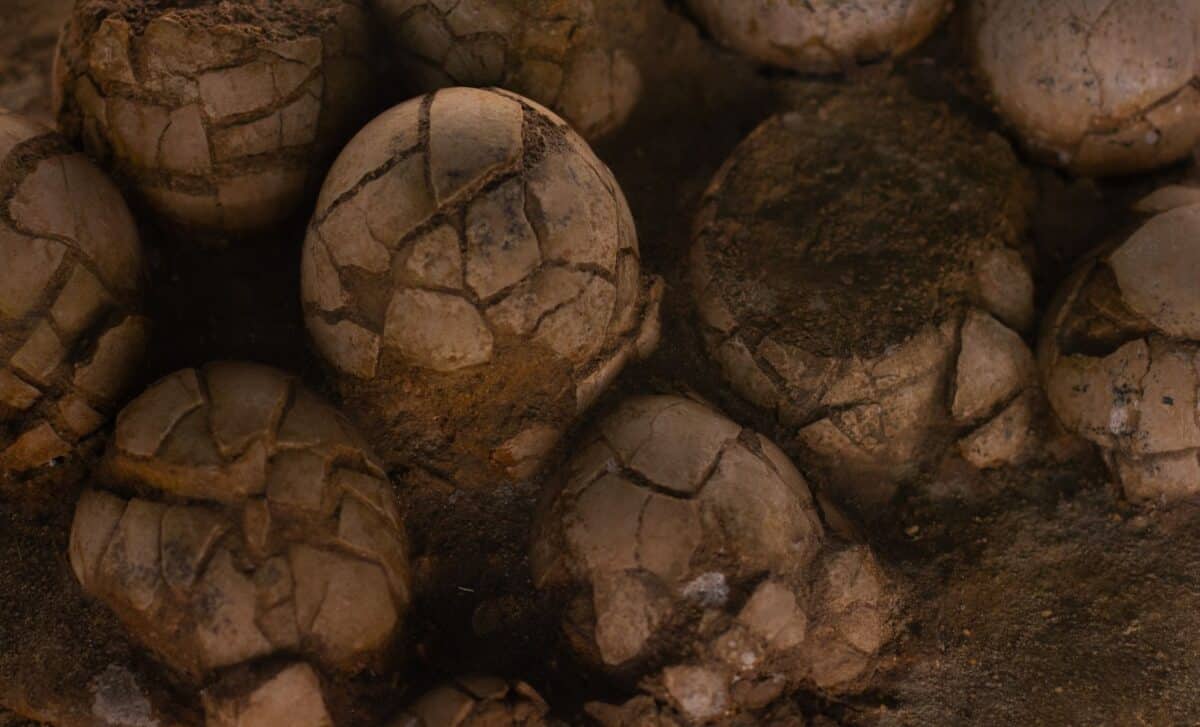
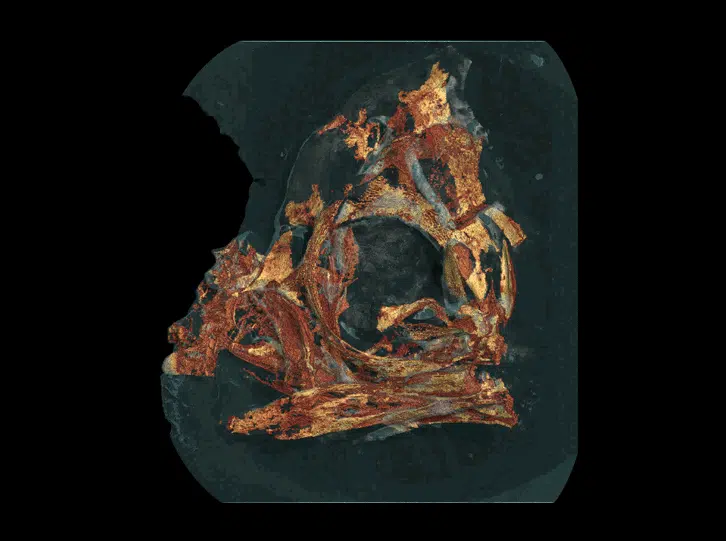
A cluster of fossilized dinosaur eggs discovered nearly five decades ago has revealed new secrets after being scanned with a stadium-sized particle accelerator. The high-resolution imaging allowed researchers to reconstruct the skulls of embryos preserved inside the eggs for 200 million years.
The fossils were first uncovered in 1976 in South Africa’s Golden Gate Highlands National Park. The six-egg cluster contained embryos of Massospondylus carinatus, a bipedal herbivore from the early Jurassic period that could reach lengths of up to 16 feet in adulthood.
For decades, the embryos remained difficult to study because of their extreme fragility and minute size. Their small dimensions and delicate preservation meant traditional imaging techniques offered limited results. That constraint changed when researchers turned to one of Europe’s most powerful scientific facilities.
A Massive Accelerator Unlocks Microscopic Detail
In 2015, researcher Kimberley Chapelle and colleague Jonah Choiniere transported the fossils to the European Synchrotron Radiation Facility (ESRF) in Grenoble, France. The installation features a 2,769-foot ring in which electrons are accelerated to near light speed, generating intensely bright X-ray beams.
According to the study Scientific Reports, the synchrotron radiation produced at the ESRF is vastly brighter than a hospital X-ray source and thousands of times more sensitive to density differences. This sensitivity allowed scientists to distinguish fossilized bone from the surrounding rock matrix with exceptional clarity.
Chapelle explained that no laboratory CT scanner can generate comparable data. Co-author Vincent Fernandez of the Natural History Museum in London stated that only a facility like the ESRF can reveal such hidden anatomical details. The scans were so detailed that individual bone cells became visible. Processing the resulting data took nearly three years back at the university laboratory.
“I was really surprised to find that these embryos not only had teeth, but had two types of teeth. The teeth are so tiny; they range from 0.4 to 0.7 mm wide. That’s smaller than the tip of a toothpick,” she explained.
Tiny Skulls Reveal Two Distinct Sets of Teeth
Among the most striking results was the discovery that each embryo had two distinct dental arrangements. Researchers report that one set, composed of triangular teeth, was likely temporary and absorbed or shed before emergence from the egg. The second set closely resembled adult teeth and would likely have been present at hatching.
For Chapelle, the complexity was unexpected given the embryos’ minute proportions. The existence of two successive tooth generations reflects a sophisticated developmental system already in place during the early Jurassic.
Reptile-Like Development Spotted in Fossils
Beyond the teeth, the scans also provided insight into skeletal development. Previously imaged arms and legs from the same cluster indicated that Massospondylus hatchlings walked on two legs. Researchers noted striking similarities between these embryos and modern reptiles and birds. As explained by the co-author of the study:
“It’s incredible that in more than 250 million years of reptile evolution, the way the skull develops in the egg remains more or less the same. Goes to show—you don’t mess with a good thing.”
Choiniere remarked that it is remarkable how little this aspect of reptile biology has changed over immense spans of time.
First Appeared on
Source link





Leave feedback about this