

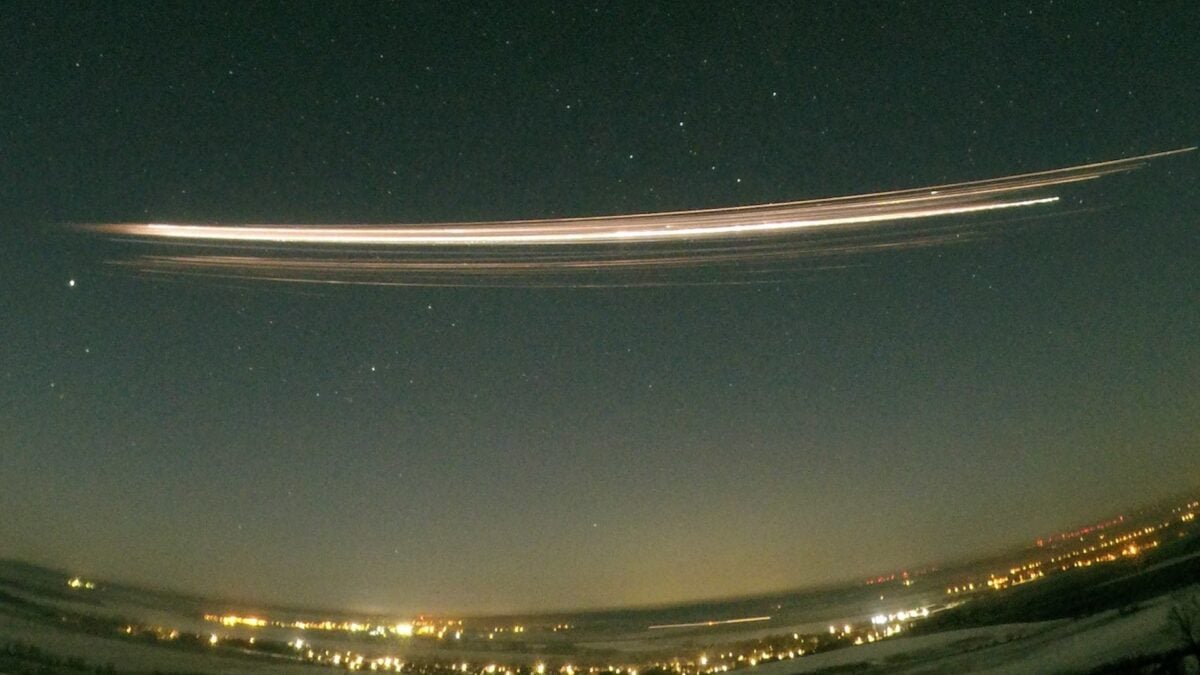
On February 19, 2025, a Falcon 9 rocket fell back toward Earth in an uncontrolled reentry, producing a massive fireball in the skies over Europe. On its way down, the rocket came near a lidar station in Saxony, Germany, where a team of researchers was able to use the remote-sensing instrument to measure the effect of the rocket reentry on Earth’s atmosphere.
“We planned to make the measurement on the chance that we might see something from the re-entry,” Robin Wing, a researcher at the Leibniz Institute of Atmospheric Physics at the University of Rostock in Germany, told Gizmodo.
Wing and his colleagues measured a 10-fold concentration of lithium atoms in the upper atmosphere around 20 hours after the uncontrolled re-entry of the Falcon 9 rocket. Increasing amounts of metal, such as lithium, as a byproduct of the modern-day space race, are beginning to alter the chemical composition of Earth’s atmosphere. The findings are detailed in a new study published Thursday in Nature.
Skyfall
As spacecraft reenter through the atmosphere, they slowly disintegrate into smaller fragments that burn up and release metals into the upper atmosphere. Lithium, as well as aluminum and other metals used to construct spacecraft, vaporizes during atmospheric re-entry.
The researchers behind the new study chose to measure lithium because it’s an effective tracer of space debris pollution and is commonly used in spacecraft. “We discussed several materials, and lithium gave a good compromise of expected signal and challenges in the lidar setup,” Wing said. “We know that lithium is present in the aerospace-grade lithium-aluminum alloys used in spacecraft construction.”
Although the risks of space debris falling onto the ground are well-studied, there is very little known about the effects of falling spacecraft on Earth’s upper atmosphere.
Using lidar—a laser-based remote sensing instrument used to measure atmospheric conditions—the team of scientists behind the new study detected a sudden increase in the concentration of lithium atoms, around 10 times the baseline value found in the atmosphere, on February 20, 2025. This lithium plume stretched from around 58 to 60 miles (94 to 97 kilometers) above sea level.
The researchers observed the plume for 27 minutes until data recording stopped. They then traced the plume of pollution to the Falcon 9 reentry, linking its area of origin to the uncontrolled path taken by the rocket on its way down.
Uncertain future
The recent study focuses on the amount of lithium left behind from a single rocket reentry. Previous studies have already shown that lithium, aluminum, copper, and lead left behind from the reentry of spacecraft already exceeds the cosmic dust influx of those metals to the atmosphere.
It’s not clear yet how exactly this change in the atmospheric chemistry would affect life on Earth, but the researchers behind the new study believe that there is enough reason for concern. Still, more research is needed to narrow down the impact on our planet.
“There are many elements present inside spacecraft which are not very present in our atmosphere due to natural causes,” Wing said. “We know very little about what metals actually exist in the atmosphere and how that relates to re-entry pollution.”
First Appeared on
Source link






Leave feedback about this