

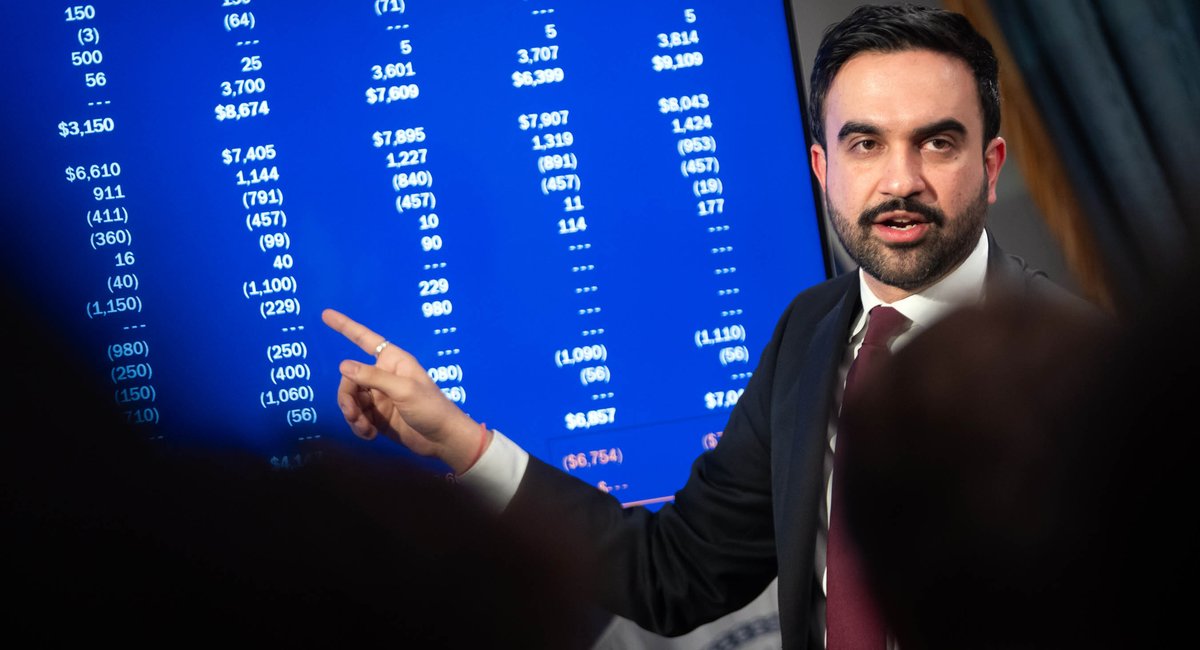
Mayor Zohran Mamdani’s threat to raise property taxes is facing broad pushback from city lawmakers and budget watchdogs who say his fix for a multibillion-dollar budget gap is a “false choice” that could drive some owners into foreclosure and trigger rent hikes for market-rate tenants.
After a campaign that won in large part by celebrating New York City, Mamdani’s $127 billion preliminary budget proposal amounted to a jarring shift in rhetoric. The city, he said, is in a “fiscal crisis” that leaves only two options: State lawmakers must raise taxes on the rich and corporations, or Mamdani will ask the City Council to hike property taxes by 9.5%. But critics weren’t buying it.
“It is a false choice,” said Andrew Rein, head of the fiscally moderate Citizens Budget Commission, “because it left out the most important option, which is to reduce spending that doesn’t improve people’s lives.”
Another veteran budget watcher took a more cynical view. “It’s a way to freak everybody out and make it look like the income tax increase is reasonable compared to this,” said Carol Kellermann, the previous Citizens Budget Commission president.
Watchdogs say Mamdani’s proposal reflects more political gamesmanship than honest accounting as he tries to keep pressure on Gov. Kathy Hochul and the state Legislature to tax the rich. Critics also say Mamdani’s either-or approach risks other unintended consequences — including alienating homeowners of color, who he has said have been unfairly penalized under a “broken property tax system.”
Since last month, Mamdani has been sounding the alarm about the state of the city’s fiscal health. He first warned of a $12 billion budget gap that shrank to $7 billion by the time he faced Albany lawmakers. The gap narrowed yet again, this time to $5.4 billion, on Monday thanks to a boost in state funds from Hochul, on top of what she had already committed to help the city expand child care.
Mamdani is legally required to balance the budget.
But Queens Borough President Donovan Richards, who endorsed Mamdani, called the possible 9.5% property tax hike “a nonstarter.”
“To enact such a significant property tax increase across the board would only worsen our wealth inequality and overall affordability crises, while threatening to return us to the days of the 2008 financial catastrophe, when Southeast Queens [was] the national epicenter of property foreclosures,” he said in a statement.
Richards said the city needed to focus on reforming a broken property tax system, “one that sees Black and brown homeowners in middle-class communities paying more than brownstone owners in the city’s most affluent neighborhoods.”
In his inauguration speech, Mamdani also called for reforming the “long-broken” property tax system.
Owners of city apartment buildings criticized Mamdani for threatening to raise their costs before fixing the property tax system.
“Mayor Mamdani promised that he would fight for property tax reform to help overtaxed apartment buildings when he was on the campaign trail,” said Kenny Burgos, New York Apartment Association CEO. “Now he is proposing an across the board tax hike that will drive thousands of rent-stabilized buildings into further bankruptcy.”
Burgos said the pain will also extend to owners of market-rate buildings and their tenants.
“This is basic economics,” Burgos said.
He said if the single largest expense goes up for building owners, those costs need to go somewhere for a building to keep operating safely. “The most obvious outcome is this added cost gets passed onto free market tenants,” he said.
Mamdani said his administration planned to submit proposed legislation to Albany “in the next few weeks” to fix the property tax system.
“What I am showcasing to New Yorkers is that there is one tax the city can raise. It is a broken property tax system,” Mamdani said.
But some say Mamdani doesn’t actually need Albany to fix the property tax system.
Martha Stark, former finance commissioner during the Bloomberg administration and policy director for Tax Equity Now New York, filed a lawsuit in 2017 challenging the city’s property tax system for being discriminatory and unfairly burdening owners in communities of color by assessing properties at different rates depending on location.
“The Court of Appeals made it clear that the city has the authority and legal obligation to assess properties uniformly. Right now, inequities are deepening for homeowners, tenants, and modest co-op and condo owners across the city. A lawful system can start today,” Stark said.
City Council Speaker Julie Menin and Finance Chair Linda Lee issued a joint statement that said a potential property tax hike, “should not be on the table whatsoever.”
The lawmakers also noted that this is the start of a process that now shifts to their side of City Hall, where agencies will be called to testify at budget hearings. They said the Council would release its own budget projections ahead of those hearings.
But even some likely administration allies in the Council were skeptical that Mamdani could push a property tax system overhaul while also keeping up the pressure to raise income taxes.
“There’s no likelihood of us passing property tax reform in Albany this year,” City Councilmember Lincoln Restler of Brooklyn said, “That being said, we need to start that debate and I commend the mayor for pushing and using his capital to advocate for making our property tax system more fair.”
“The City Council has the authority to increase property taxes but it’s not the thing we want to do, it’s not the optimal choice and we’ll be looking at every option to try and avoid that,” he added.
Still, other city policy experts say that the city does have more revenue raising options if it thinks more creatively.
The left-leaning Center for an Urban Future issued a report last week detailing five different ways the city could generate revenue. One of those options — a 25% increase in the number of metered parking spaces on city streets — would raise $1.3 billion annually by their estimates and does not require any action from Albany.
“The reality is that there are numerous budget options available to the city. Some are going to bring in a lot more revenue than others and not all of them can be implemented this year,” said Jonathan Bowles, the center’s executive director. “But the city’s deficits also don’t end this year, so I think it would be silly to shoot down alternative options of raising revenue at this point.”
First Appeared on
Source link


Leave feedback about this