

Democrats would be favored to win seven of Colorado’s eight congressional seats in 2028 and 2030 — up from the four seats the party controls now — under a redistricting plan that would plunge the state into the national fight over gerrymandering.
The proposal, unveiled Wednesday by a new organization called Coloradans for a Level Playing Field, whose funders are unclear, would ask voters to temporarily override the independent redistricting process that they enshrined in the constitution less than a decade ago.
It will take millions of dollars just to gather the signatures to get a question on the ballot.
But the plan is the most serious attempt yet to enter Colorado into the national redistricting battle as the major political parties vie for control of the U.S. House. While two other Colorado groups are already working on redistricting plans, Coloradans for a Level Playing Field appears to have big financial backing — and the committee has already drawn a map with new congressional districts for voters to consider.
“No one wanted to have to take this action — independent redistricting is the ideal,” Curtis Hubbard, a spokesman for Coloradans for a Level Playing Field, said in a written statement. “But with Donald Trump and MAGA Republicans actively working to rig Congressional elections, resulting in the potential gain of up to 27 seats in Congress, Colorado must join other states in countering this unprecedented power grab.”
He added: “We can sit back and do nothing, or we can take action to approve temporary maps that will help keep our elections on a level playing field.”
The Coloradans for a Level Playing Field proposal would ask voters to adopt a new congressional map in Colorado for the 2028 and 2030 elections before letting the state’s independent congressional redistricting commission draw a new map for the 2032 election as planned based on 2030 census data.

Colorado’s current congressional map was drawn by the commission in 2021. Voters handed congressional and state legislative redistricting power to the commission in 2018 by passing a pair of ballot measures amending the state constitution.
Hubbard declined to say who is funding Coloradans for a Level Playing Field, which formed as a state issue committee Feb. 4 and won’t have to report its donors until May. But the organization is clearly tied to Democratic interests.
The group’s registered agent, Rachel Gordon, is a political operative who works on Democratic campaigns and causes. Hubbard also frequently works with Democrats. And Hilltop Public Solutions, a Democratic political firm, is also working on the measures.
Coloradans for a Level Playing Field is also working with one of the existing groups working on redistricting in Colorado, called Colorado Draws the Line. That organization, a nonprofit formed in January, has raised $700,000 so far, according to Val Nosler Beck, a Democratic strategist leading the effort.
The new districts
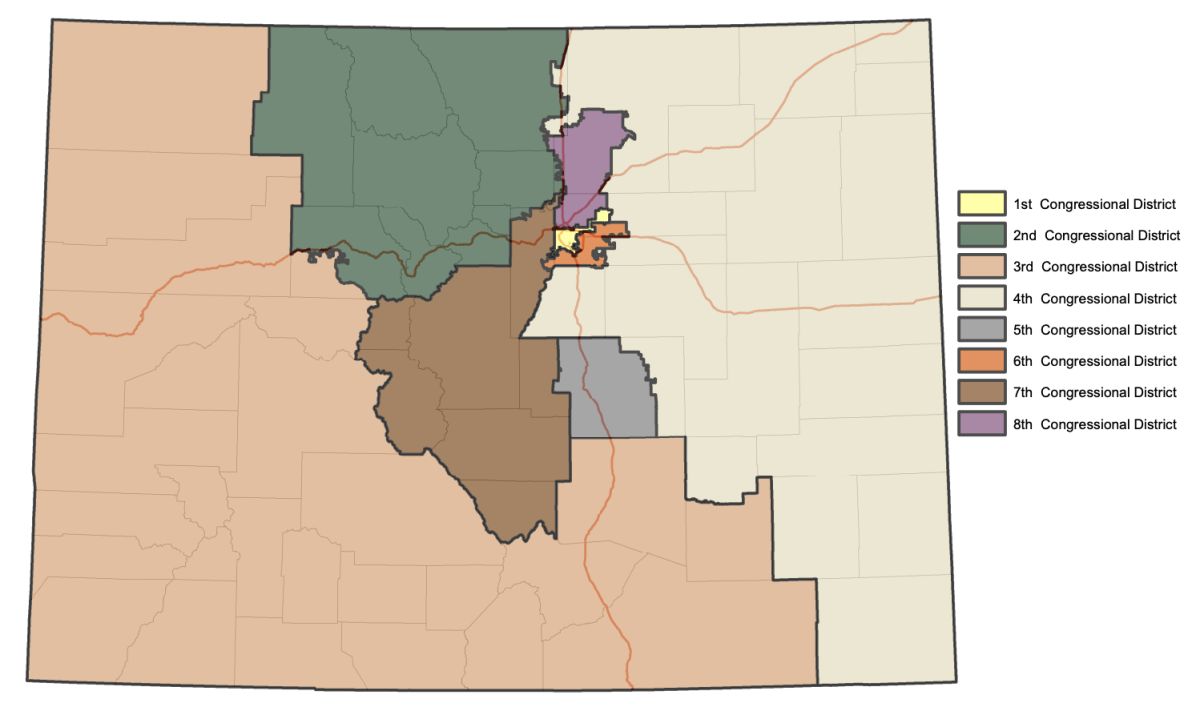
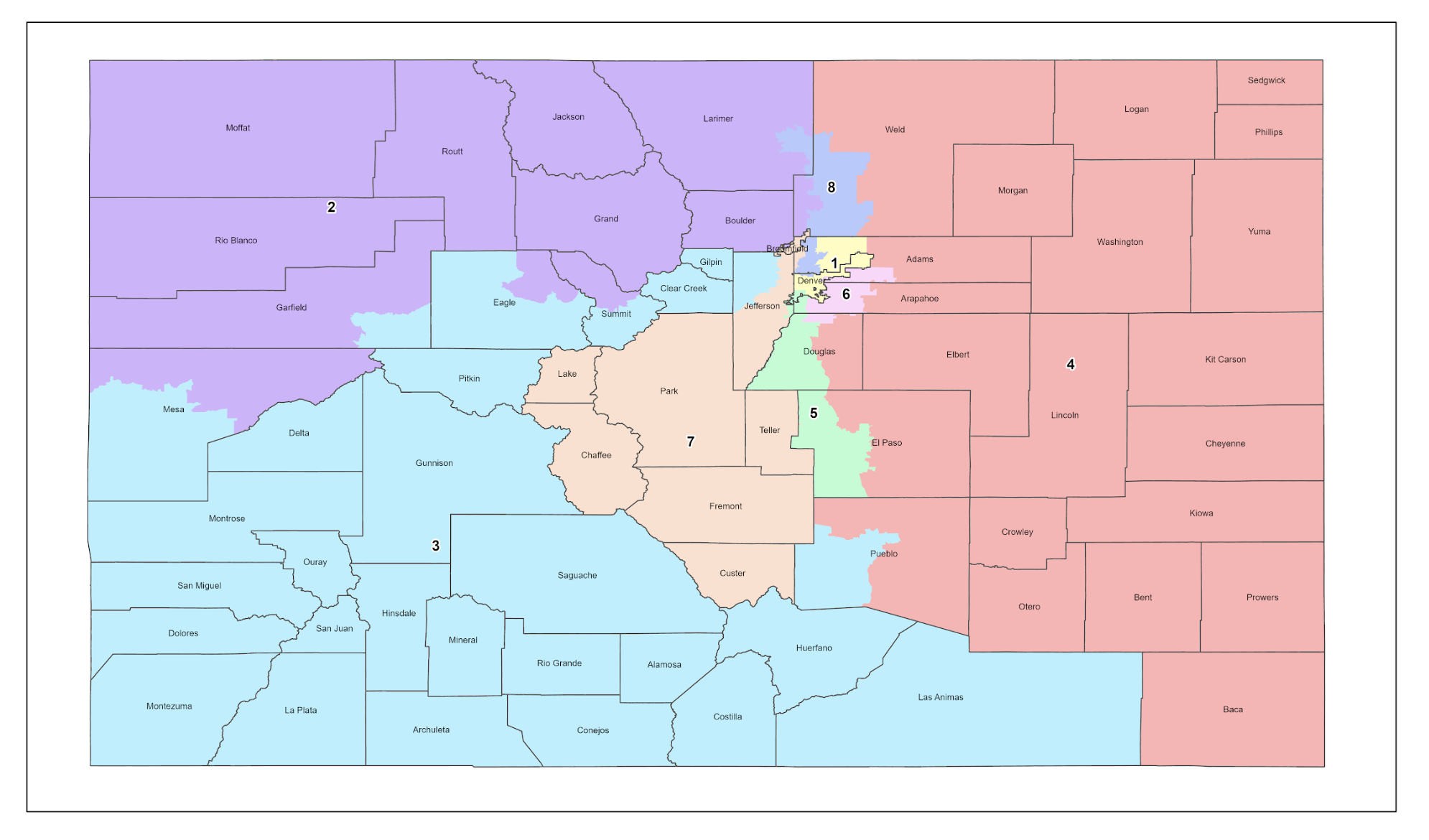
The new congressional districts proposed by Coloradans for a Level Playing Field would make it easier for Democrats to win in the 3rd, 5th and 8th congressional districts, seats that are currently held by Republican U.S. Reps. Jeff Hurd of Grand Junction, Jeff Crank of Colorado Springs and Gabe Evans of Fort Lupton.
The 8th District, which runs along U.S. 85 from Denver’s northeastern suburbs into Greeley, would be shifted south and west into Denver and western Adams County, two Democratic strongholds. Fort Collins, a Democratic city, would also be in the new district.
The 5th District, which is contained to El Paso County, would shift to the western half of El Paso County and north into Douglas County, as well as the southern — and Democratic — parts of Jefferson, Denver and Arapahoe counties.
The 3rd District, which spans the Western Slope into Pueblo and southeastern Colorado, would be moved south and east into more of Eagle County, as well as Summit, Clear Creek, Gilpin and, most consequently, northwestern Jefferson County. The new parts of the proposed district lean in Democrats’ favor.
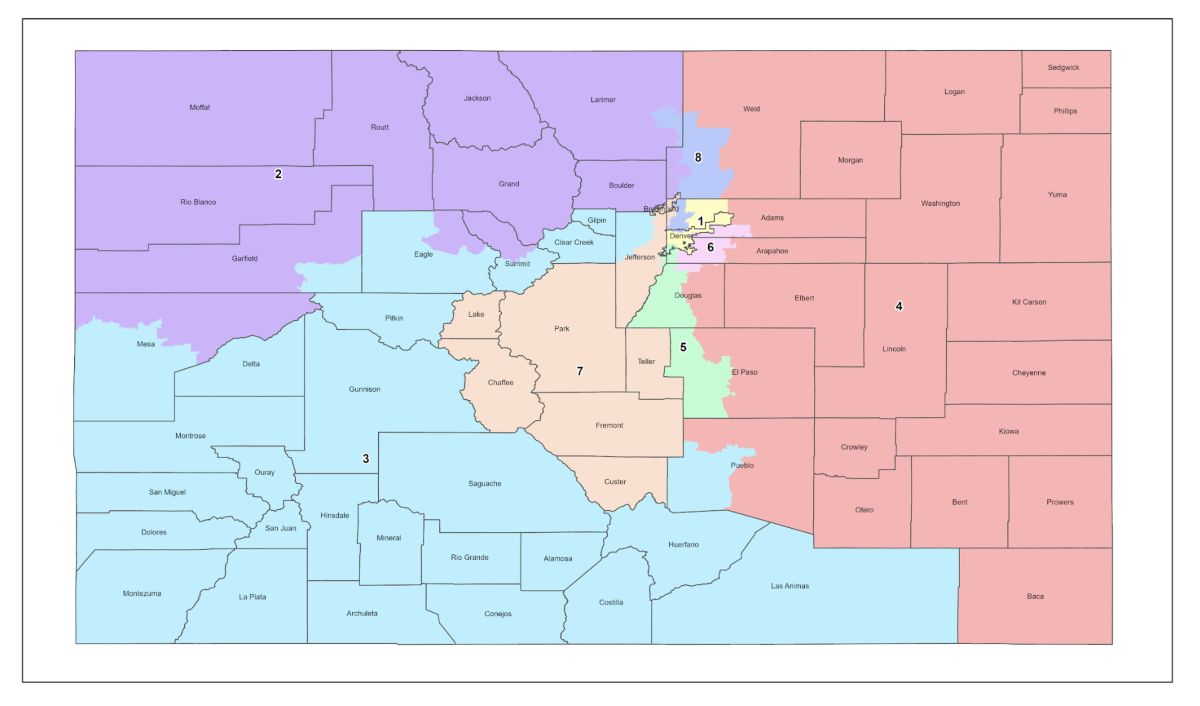
Democrats would give up some of their security in the 1st, 2nd and 7th congressional districts as a trade-off — represented by Democratic U.S. Reps. Diana DeGette, Joe Neguse and Brittany Pettersen — by shifting parts of those districts into Republican areas. But the party’s past margins of victory in those districts have been so large that the changes likely wouldn’t pose a real threat.
Republicans would maintain their big advantage, if not grow it, in the 4th Congressional District, which is held by Republican U.S. Rep. Lauren Boebert of Windsor. The district is contained to the Eastern Plains.
Because Colorado’s redistricting process is laid out in the state constitution, only an amendment to the constitution can change it. And a change in the state constitution can only happen with voter approval.
Measures removing sections of the constitution need a simple majority to pass while adding to the constitution requires the approval of 55% of the electorate.
Getting a measure on the ballot that would amend the constitution is very difficult. It requires gathering about 125,000 voter signatures, including from at least 2% of the voters in each of Colorado’s 35 state Senate districts. That task can cost upward of $2 million on paid signature gatherers.
Coloradans for a Level Playing Field is pursuing a handful of proposals and will move forward with one of them depending on how the initiatives fare in the state’s ballot measure review process.
The new Colorado redistricting push comes as the top Democrat in the U.S. House, Minority Leader Hakeem Jeffries of New York, hinted to CNN over the weekend that Colorado was one of the states he is targeting for redistricting in Democrats’ favor.
“Republicans started this redistricting war,” he said, “and Democrats have made clear we’re going to finish it. We’re going to make sure there’s a fair national map.”
Jeffries said Democrats were willing to spend whatever it takes to win the fight.
The redistricting tit for tat began after Trump called on Republican-led states to redraw their congressional maps to help the GOP maintain their majority in the U.S. House after the midterms. Texas took up the mantle first, which prompted California Democrats to redraw their state’s map through a successful ballot measure amending the state constitution in November.
Other states — Democratic- and Republican-led — have followed suit with redistricting efforts in their party’s favor, many of which are still pending.
First Appeared on
Source link






Leave feedback about this