

In a 2025 survey, we asked people in 25 nations to say – in their own words – what makes them proud of their country. In several ways, Americans’ answers stand out from those of people in other countries.
Americans are among the most likely to emphasize freedom as a source of pride. They are also more likely than people in many other surveyed nations to offer a negative sentiment when asked what makes them proud. And Republicans and Democrats tend to highlight different sources of pride – a partisan divide that is not as pronounced in most other countries.
Here is a closer look at national pride in the United States, including how it’s similar to or different from national pride in other countries. The analysis includes direct quotes from some Americans to highlight key themes that were mentioned by multiple respondents. To learn more about sources of pride in the other 24 countries surveyed, read “What Makes People Proud of Their Country?”
Freedom is the top source of pride in the U.S. Americans are most proud of their freedom: 22% name this as a reason they are proud of their country. Many people say this in other countries, too, particularly in the Netherlands, Sweden and France. But the U.S. is the only surveyed country where freedom is the single most frequently mentioned source of pride.
One 52-year-old American man said he is proud of “strong free speech, freedom of assembly, freedom of religion, [and] general civil liberties,” highlighting the range of freedoms that many Americans take pride in.
When asked what makes them proud of their country, one-in-five Americans offer something negative or critical instead. Some Americans say they don’t feel proud of the U.S., including many who say they were previously proud of it but no longer are. In only a handful of other surveyed nations – including the United Kingdom, Spain and Nigeria – do people express as much or more negativity as Americans do on this question. (For more, read “Where, and why, people aren’t proud of their country.”)
One 44-year-old American man said there is “nothing to be proud of currently.” Another man said, “I used to be very proud of the United States, but since the reelection of Donald Trump I’m not proud of the United States at all.” Many Democrats explicitly tie their lack of pride in the U.S. to the current administration and its policies.
Democrats and independents who lean toward the Democratic Party are four times as likely as Republicans and those who lean Republican to say something negative (32% vs. 8%). But this pattern is not unique to the U.S. In many countries, people who do not support the governing party or parties are more likely than party supporters to say they are not proud of their country. Attitudes about pride in one’s country often may shift as different parties come into office. This pattern appears in other areas, too, such as views of the economy or satisfaction with democracy.
Republicans and Democrats emphasize different things when it comes to their pride in the U.S. Republicans are about twice as likely as Democrats to say they are proud of freedom (32% vs. 15%).
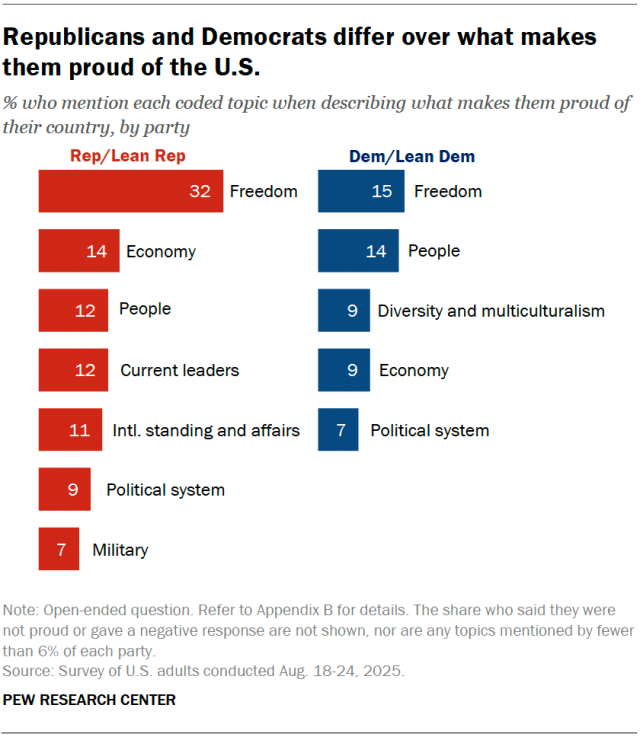
Still, freedom is a source of pride for Democrats, even if they mention it less often than Republicans do. As one Democratic woman said, “I am proud to be an American because our citizens are free to speak up about the dictator that resides in the White House.”
Many Republicans take pride in the nation’s current leadership, its international standing and affairs, and the U.S. military. These all rank among the top sources of pride for Republicans but not for Democrats.
For Democrats, diversity and multiculturalism rank among the top sources of pride, but the same is not true for Republicans.
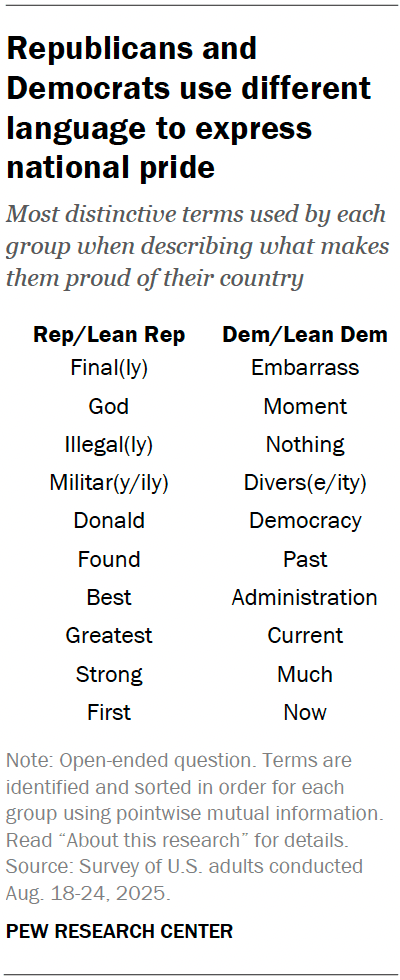
Republicans and Democrats differ in the specific words they use when sharing what they are proud of. Republicans are much more likely than Democrats to mention President Donald Trump and God, as well as to use the words “best” and “greatest.” They are also more likely to use the term “illegal” and mention the military.
One 64-year-old Republican woman used some of these words in her answer: “Donald Trump and his Cabinet …. Our country is no longer a laughing stock worldwide and is now a military and economic superpower. We are respected by the entire world and our economy is booming once again. We’re cracking down on crime and dealing with gangs and thugs and illegal aliens.”
Democrats, in turn, frequently contrast the past and present when talking about what makes them proud of the U.S. Some of the distinctive words Democrats use include “moment” and “past.” For example, a 38-year-old Democrat said, “At the moment? Not much. In the past, our sense of freedom, liberty and equality.” (For more on how we ranked the distinctiveness of the words used, read About this research.)
When asked what makes them proud, Americans are more likely than people in many other nations to mention their country’s current leader by name. In the U.S., 6% of respondents name a political leader or party as a source of pride. The vast majority of these respondents name Trump, though a small share of people mention other leaders, including California Gov. Gavin Newsom and references to “Democrats” or the “Democratic Party.”
Compared with people in other countries who mention being proud of their national leadership, Americans are among the most likely to use their national leader’s name. About six-in-ten Americans who are proud of their country’s leaders mention Trump specifically, rather than just referring to the office of the president. Across all the surveyed countries, by comparison, a median of 35% of those who are proud of their national leader mention them by name.
Few Americans (3%) mention U.S. history as something that makes them proud of their country. By comparison, far more people mention this as a source of pride in Greece (37%), France (22%), Hungary (21%) and Poland (20%).
Among the Americans who do mention history as a source of pride, more mention the nation’s founding – including the Founding Fathers, the writing of the country’s founding documents or the U.S. gaining independence – than any other historical event or period. Fewer mention things like the abolition of slavery, women’s suffrage, World War II or the Marshall Plan. Republicans are also more likely than Democrats to mention the nation’s founding as a source of pride.
For one man, the founding of the U.S. inspires pride in “ingenuity, the way our Founding Fathers tried to think of future generations.” Another man said he is proud that “our Founding Fathers set [the U.S.] up almost 250 years ago.”
Some people also contrast the founding of the U.S. with the country today. One man said, “I am proud of our history and the ideals upon which we are founded … I am saddened by the ugly turn we have taken of late, and what it has done to innocents around the world, those most vulnerable here, and our reputation.”
A 41-year-old man declared himself proud of “the ideals that our country was founded on and has stood for – equality, liberty, freedom of religion, freedom of expression, freedom of the press … I worry lately that so much of this is being erased, forgotten, and replaced with things that I am not proud of.”
Note: Here is the survey question used for this analysis, with findings by topic. For a full, ordered list of responses by country, refer to the detailed tables in Appendix E.
First Appeared on
Source link


Leave feedback about this