

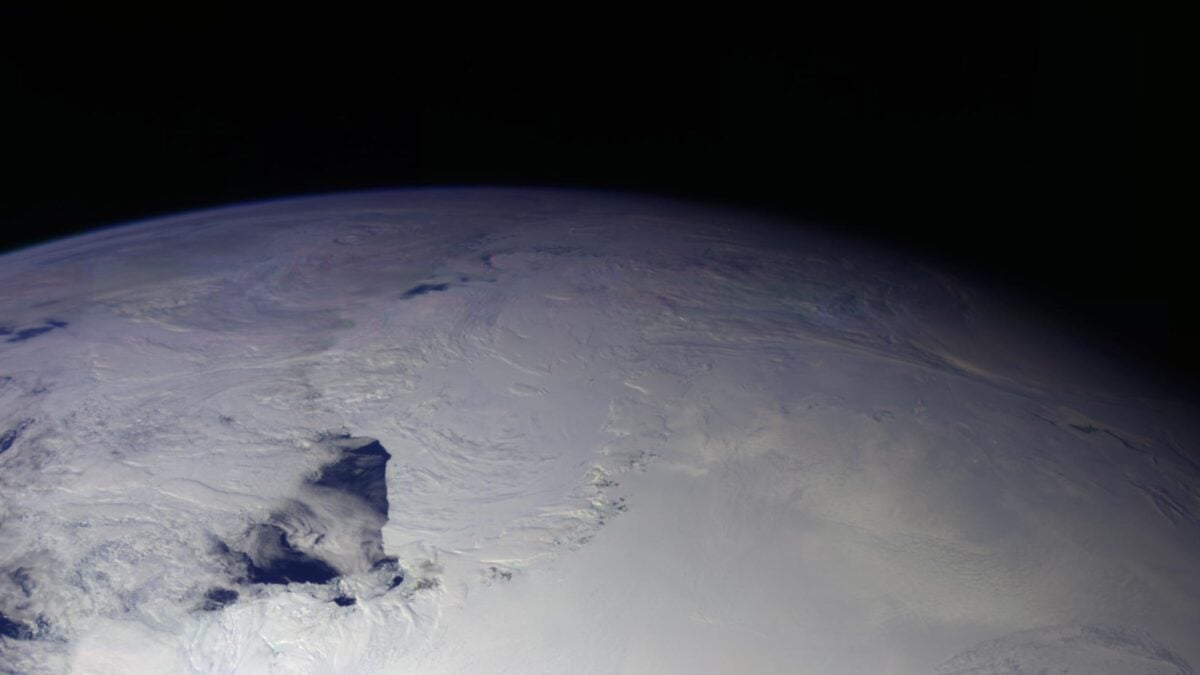
For a long time, scientists knew of a “gravity hole” beneath Antarctica—an area with particularly weak gravitational force. Considering the various threats currently faced by the region, scientists are hoping to understand this anomaly better. At last, they may have a new lead.
Perhaps unsurprisingly, any shifts in Antarctica’s gravity overlap with major shifts in the region’s climate and geology. A historical analysis of Antarctica’s gravity hole, detailed in a recent Scientific Reports paper, explains that the hole started off weaker but grew stronger between 50 and 30 million years ago, when widespread glaciation took over Antarctica.
However, the team has yet to ascertain whether and how the gravity hole could impact Antarctica, especially as the effects of climate change worsen each year.
Not all spots are equal
The geoid is the bumpy, irregular ocean surface shaped by Earth’s gravitational influence. Gravity varies across regions on Earth, although these differences are small enough that you never see someone flying or getting crushed from gravitational anomalies. For you and me, it’s exceptionally subtle; for water, these differences in gravitational pull can exert a meaningful impact.
Indeed, these variations exert significant influence on Earth’s oceans. For instance, water tends to flow toward areas of stronger gravity, so sea levels in regions with relatively lower gravity, like Antarctica, are typically lower than expected.
The “low” here refers to a “broad depression in Earth’s gravity field caused by a deficit of mass at depth,” explained the researchers in a release from the Paris Institute of Earth Physics.
Tracking gravity’s path
For the study, the team reconstructed the 3D structure inside Earth using global earthquake recordings and “seismic, geodynamic, and mineral-physics data,” according to the paper. The team’s model accounted for elements such as mantle dynamics, gravity field data, and changes to Earth’s rotational behavior.
“Imagine doing a CT scan of the whole Earth, but we don’t have X-rays like we do in a medical office. We have earthquakes,” Alessandro Forte, the study’s senior author and a geophysicist at the University of Florida, said in a university statement. “Earthquake waves provide the ‘light’ that illuminates the interior of the planet.”
The researchers then used a similar technique to “rewind the flow of rocks in the interior and track changes back 70 million years,” according to the statement. The simulations revealed that initially, a cold, dense material sinking into the deep mantle drove the gravity low near Antarctica.
Then, between roughly 50 and 30 million years ago, hotter, lighter mantle began rising from deep inside, redistributing mass across the continent. The combination of the cold, sinking mantle and the hot, rising mantle amplified the overall deficit of mass below Antarctica, the study explained.
Things that sink
Since sea levels and tide dynamics subsequently influence climate patterns, researchers believe that better understanding the gravity hole will lead to new insights into Antarctica’s geological history—especially given the threats looming over the region today.
“If we can better understand how Earth’s interior shapes gravity and sea levels, we gain insight into factors that may matter for the growth and stability of large ice sheets,” Forte said.
First Appeared on
Source link





Leave feedback about this