

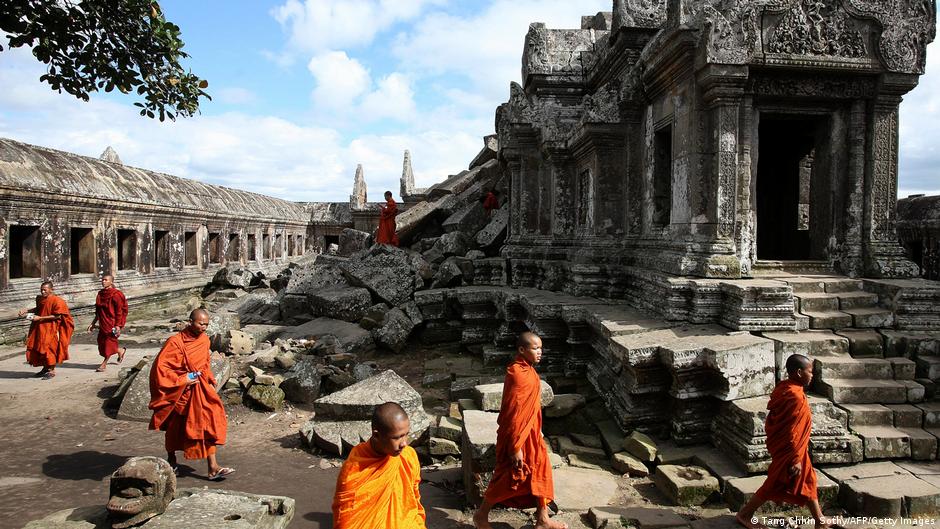
Cambodia has requested French assistance, including access to historical boundary documents and colonial-era maps, in hopes of resolving its ongoing border dispute with Thailand.
This month, Cambodian Prime Minister Hun Manet wrote to French President Emmanuel Macron, saying that it would also welcome expertise and advisory support from the former colonial power.
“The prime minister firmly believes that France’s continued engagement will serve the shared objective of achieving a just and lasting solution, allowing the Cambodian and Thai peoples to live side by side in peace, security, good neighborliness and prosperity for generations to come,” Cambodia’s Foreign Ministry said in a press release.
France ruled Cambodia as a protectorate from 1863 until independence in 1953. The 817-kilometer (507-mile) border between Cambodia and present-day Thailand was first mapped by French officials in 1907, based on the “watershed” principle that separates the basins of the Mekong and the Tonle Sap rivers.
Preah Vihear temple in focus of clashes
With France pulling out of the region, however, the demarcation line became the focus of a bitter and occasionally deadly dispute. Thailand and Cambodia have repeatedly clashed over territory, especially the area surrounding the 11th-century temple of Preah Vihear, which both sides view as a potent nationalist symbol.
Thailand has long argued that the temple in fact lies north of the watershed line, as described in the treaties, and should therefore be under Bangkok’s control; Cambodia, in turn, relied heavily on the maps which place the site on its side of the border.
In 1962, the International Court of Justice(ICJ) ruled that the temple belonged to Cambodia. In 2013, following a brief border war between the two countries five years earlier, the ICJ upheld Cambodia’s sovereignty.
Tensions escalated once again last year, turning into open fighting in July, then flaring up again in early December before a new ceasefire was declared on December 27. At least 149 people have been killed so far, most of them civilians. Hundreds of thousands of people have been displaced, with an estimated 800,000 Cambodian migrants leaving behind their lives in Thailand and returning home.
‘Colonialism is the original sin’
Hun Manet’s latest appeal to France has also revived a broader, uncomfortable question of how contemporary conflicts in Southeast Asia continue to be shaped by colonial-era boundaries.
“Colonialism is the original sin which the Myanmar Civil War, the Thai-Cambodia border war, the ongoing territorial disputes between Indonesia and Malaysia over Borneo, and many others still ongoing in Southeast Asia descended from,” Bernard Keo, assistant professor of International History and Politics at the Geneva Graduate Institute, told DW.
The fragmentary process of decolonisation in the post-World War II period “resulted in the creation of post-colonial nation-states that continue to grapple with a range of unresolved questions,” Keo told DW.
International courts value colonial-era maps
Cambodia, the smaller nation facing a militarily powerful opponent in Thailand, has increasingly framed its dispute with Thailand as one governed by international law.
“Appealing to France for assistance with historical and technical documentation would help strengthen Cambodia’s legal position in maintaining its territorial boundaries,” Soksamphoas Im, associate director of the Asian Studies Center at Michigan State University, told DW.
Because colonial-era boundary maps continued to be officially recognized by the International Court of Justice and the United Nations, it would put Cambodia in a stronger position to confront Thailand, Im noted.
After a Cambodian soldier was killed in May 2025, Hun Manet said Cambodia would seek a ruling from the ICJ. During later escalations, Cambodia also appealed to the UN Security Council, while Thailand publicly rejected international mediation offers and reiterated its preference for a bilateral solution.
She noted that the 1947 British “Radcliffe” border line between India and Pakistan is also still used by international bodies. Moreover, in the 2008 sovereignty case between Malaysia and Singapore over Pedra Branca island, the ICJ assessed extensive historical evidence, including official correspondence and colonial-era records.
What are France’s options in responding to Cambodia’s request?
Paris has not officially said whether it would accede to Phnom Penh’s latest request. Overall, the French government has tried to remain neutral since Thai and Cambodian troops started clashing last July.
If it does decide to step in, its impact could range from mundane to politically combustible.
At the cautious end, France could simply help Cambodia locate and authenticate archival documents without endorsing any interpretation. Purely technical assistance and access to French archives could indeed lower tensions, said Sophal Ear, a political scientist and associate professor at Arizona State University.
“A narrowly defined technical role might help depoliticize the discussion and anchor it in documentation,” he told DW.
However, if France were seen as substantively endorsing one side’s territorial interpretation, it could make things worse, Ear added.
“Thailand might interpret such involvement as external bias or as a revival of colonial authority in a contemporary dispute. That would risk hardening positions rather than facilitating compromise.”
Edited by: Darko Janjevic
First Appeared on
Source link




Leave feedback about this