

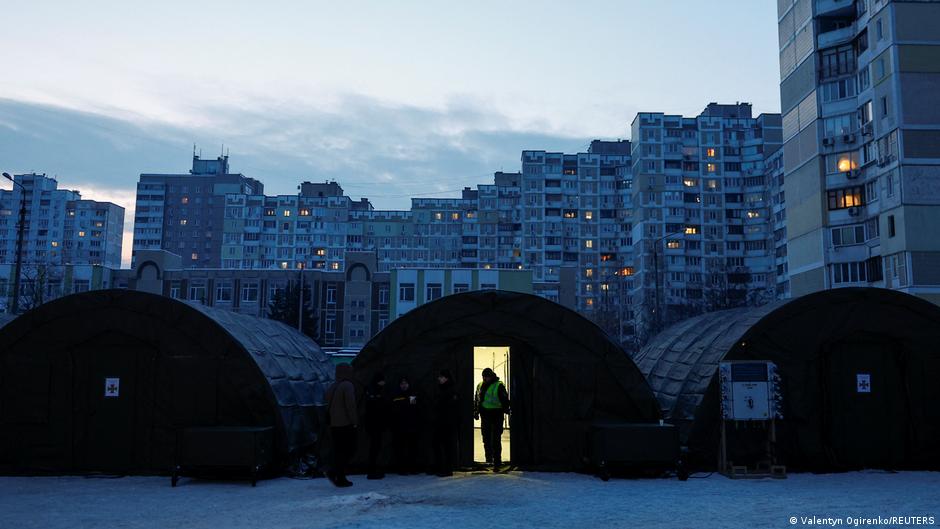
This winter, hundreds of apartment blocks in Kyiv have been transformed into towers of freezing concrete. Following massive Russian missile attacks on energy facilities in Ukraine, they are left without heat and electricity.
Not only energy company employees but also private contractors, electricians and plumbers do their best to bring the frozen buildings back to life. Their work in these icy basements often goes unnoticed, but they are very much in demand.
It is extremely difficult to find private contractors in the Ukrainian capital who can replace a power cable that has been burnt through after a network overload, or who can drain cold water from heating pipes. Entire neighborhoods can no longer be supplied with district heating because power plants have been destroyed. Wherever possible, plumbers, electricians and sanitation and heating engineers work tirelessly to reconnect households to water, heating and electricity.
Long hours and little sleep
Oleh Karpov runs a company for sanitation technology and heating engineering. He and his team are hired by homeowners’ associations to maintain the plumbing and electrical systems in Kyiv apartment blocks.
Karpov said this year is seriously testing his endurance. His workday begins at 4:00 or 5:00 in the morning, when most of the city is asleep, and finishes well after midnight.
His team has been on duty more or less around the clock since the beginning of January. His employees are physically and emotionally exhausted, he explains, but even with a 39-degree Celsius fever, they still show up for work.
“Sometimes we manage to get two or three hours of sleep. Yesterday, I came home, didn’t even wash, went to bed at 2:00 a.m. and was woken again at 5.30 a.m. We’re tired, and we’re sick, but we go where we’re needed,” Karpov said. “We know that otherwise it’ll just get even worse for the building and for the people living there.”
Struggling for workers
Karpov is a war veteran who was discharged from the army for health reasons. Most of the people on his team are older men. Some have serious injuries they sustained on the front lines and struggle with physical limitations.
“Out of 25 workers, I have eight left. Some are at the front. Others have gone abroad. People who work for private companies can’t get an exemption from military service like employees of state or municipal companies. There’s a huge lack of qualified personnel, Kaprov said.
“I have a welder who’s 62 years old and an electrician who’s over 60. Then there’s one guy who’s seriously disabled, and an installer who’s an internally displaced person from the Russian-occupied territories and who also has health problems. Young people don’t want to do this work, so we do it.”
Life-threatening situations
Emergency teams of engineers and electricians typically work quickly to help as many people as possible.
“There aren’t enough emergency personnel, so people are working for two or three days without a break. They’re on the verge of collapse. Two emergency repair workers recently died from excessive overwork. Many are suffering from physical and psychological exhaustion or frostbite,” Oleksiy Kucherenko, a member of parliament and a former minister of housing and communal services, wrote on Facebook.
The mayor of Kyiv, Vitali Klitschko, has confirmed that a 60-year-old fitter died in January while on call at an apartment. The city council is planning to provide the families of workers who died working at apartment blocks and communal facilities with a one-off financial assistance payment of 50,000 hryvnia (around 1,000 euros).
Hardest part of the job
In general, private contractors like Karpov are hired to manage buildings run by homeowners’ associations. This doesn’t mean they get to charge higher rates, since they’re locked into long-term business plans. These contracts are based on a set number of callouts and do not account for the extreme situations caused by Russian air strikes.
“So I take on work for electricians or installers myself, to spare them and give them a break,” he says.
According to Karpov, the hardest part of the work is not the utter exhaustion, the ancient pipework or the burnt-out cables. For him, it’s the basic lack of recognition.
“They accuse us of being lazy, curse us, are aggressive and expect us to defy the laws of physics. In a building of 300 apartments, there might be one person who thanks us, while the rest say we’re doing a poor job. You just get really discouraged in situations like that, and feel like giving up,” he admits.
‘We have to do something’
Leonid Kulytskyi, 59, has been working as an electrician for almost 30 years. This winter has been the hardest of his entire career, he says. He can only get home to rest for a few hours at a time.
Many Kyiv residents have no heating in their apartments because the power plants have been hit, so they make use of the few hours when there’s electricity. But the power grids aren’t designed to support so many energy-intensive appliances operating simultaneously.
“As soon as there’s electricity, people switch everything on at once: boilers, heaters, kettles. Cables, wiring, and switch boxes burn out as a result. But we have to go out and help people because they’re freezing and they’ll have no electricity at all otherwise. We have to do something, so they can get themselves warm again,” Kulytskyi says.
Despite the crushing workload, he doesn’t see himself as a hero. It’s simply his duty toward his fellow citizens, says Kulytskyi, whose son is fighting on the front line. The Ukrainian soldiers in the trenches have it far worse, he remarks.
“Russia is driving us to exhaustion. But we’re hanging in there. I do my work as best I can. The main thing is for our children to come out of this war alive and healthy.”
This article was originally written in Ukrainian.
First Appeared on
Source link






Leave feedback about this