

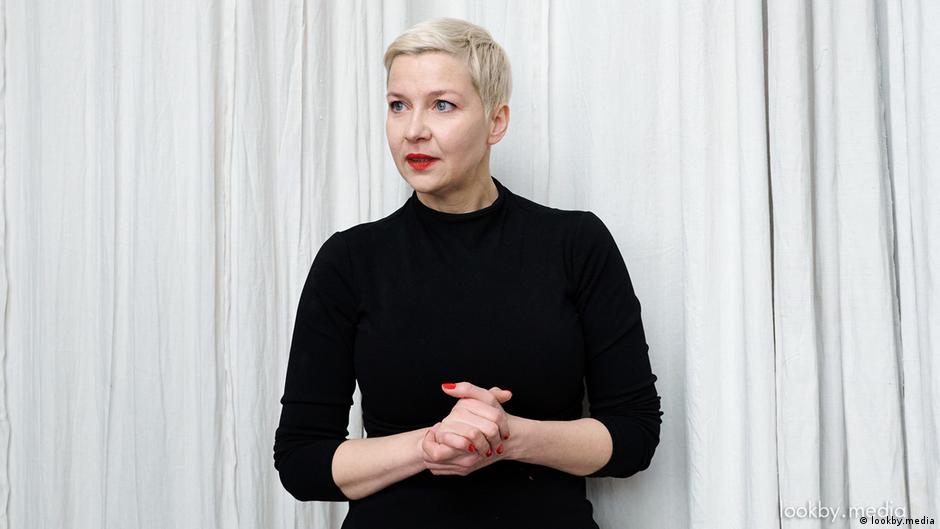
In 2020, Maria Kolesnikova — alongside activists Sviatlana Tsikhanouskaya and Veronika Tsepkalo — was a key figure in the Belarusian opposition, set against the country’s strongman leader Alexander Lukashenko.
During anti-government protests, Belarusian authorities detained Kolesnikova and took her to the Ukrainian border for expulsion. However, in the neutral zone, she broke away from security forces, ripped up her passport, making legal border crossing impossible, and fled on foot back to Belarus.
She was subsequently charged with conspiracy to seize power, among other things, and sentenced to 11 years in prison.
In mid-December, 2025, following international pressure and a US-brokered deal with Lukashenko, she was one of 123 political prisoners released from Belarusian prison. At least 1,100 political prisoners remain imprisoned.
Today, the professional flautist lives in a friend’s apartment in the German capital, Berlin, but says she’s looking for her own place there. German authorities granted her political asylum and invited her to Germany, where she received medical care.
“I feel much better than I did during the past five years,” she says.
While in prison, where she spent months in isolation, she contracted a life-threatening condition that required intensive care. She had been healthy prior to her incarceration.
What Belarusians need from the EU
She currently relies on her family for financial support and does not receive any benefits from the German state. “But I can still work, and of course, that’s what I’m going to do,” she says.
Kolesnikova has a German travel document for foreigners and a visa, but she hasn’t yet obtained a new Belarusian ID. She and the political prisoners she was released with were exiled without any papers.
“All other documents are still in the works. The German side has been very supportive, and I’m very grateful for that. Efforts are also being made to sort out issues with my bank,” she explains.
While in jail, her German bank account had been blocked — as a citizen of Belarus, she, too, had been affected by sanctions. Following Russia’s full-scale invasion of Ukraine and the support Belarus provided to Russia, the European Union sanctioned both countries.
Kolesnikova argues that the trouble she’s having with her bank account demonstrates how sanctions harm ordinary citizens without really affecting leaders like Lukashenko or Russian President Vladimir Putin.
“I can’t complain, I’m receiving so much support from so many people. But thousands of Belarusians are not. Politicians in Europe and Germany don’t grasp the pain of Belarusian citizens,” she says. “There is a huge divide between them [European and German politicians] and Belarusian refugees.”
To bridge this, she suggests European politicians pursue three goals “once the question of diplomatic initiatives between the EU and Lukashenko arises.” EU politicians should push for the freeing of political prisoners in Belarus, the end of political repression there as well as the end of the counrty’s isolation.
For now, Kolesnikova says, the most important step is the first one. “Everyone criticized me for thanking Lukashenko,” she says referring to a press conference in Ukraine after her release, where she thanked the president for freeing prisoners. “I would thank the devil if it meant people were set free.”
Kolesnikova also worries about her homeland’s isolation. “It’s important to end the country’s isolation,” she says. “It turns out it’s only benefiting Putin.” Belarusians who do not study abroad, or travel to the EU and or have connections to European culture, eventually turn eastward, she suggests.
Belarus will be ‘free one day’
Before 2020, Kolesnikova spent 13 years in Germany. “I’m well integrated in German society and have lots of friends here,” she says. “I’m part of a large community of artists, and that’s where our strength lies. In the last six years, they worked on dozens of projects that they dedicated to me, raising awareness for political prisoners in Belarus.”
Now that she has started granting interviews to German media, Kolesnikova says more people recognize her on the street. “People approach me and say they support Belarus and believe the country will be free one day,” she notes. “I’m not used to things like that. But of course, it’s nice when people recognize me and start talking about Belarus.”
During the conversation, Kolesnikova also touches on the 2020 protests against Lukashenko following a presidential election widely criticized as a sham. Lukashenko’s government responded to the protests harshly, jailing thousands. It’s estimated that half a million Belarusians fled the country because of this. Even now, the Lukashenko regime still arrests people who took part in those protests six years ago.
Kolesnikova says she doesn’t regret anything that happened back then.
“All Belarusians could see that in 2020, we were closer than ever to change. We didn’t get there with a bloody revolution, but with democratic means,” she says.
“The fact that Lukashenko got so scared and turned to such violence is another thing entirely. None of us is to blame for that. It was the decision of certain officers, security forces and Alexander Lukashenko himself to lock people up, to beat and mistreat them.”
This article was originally written in German.
First Appeared on
Source link

Leave feedback about this