

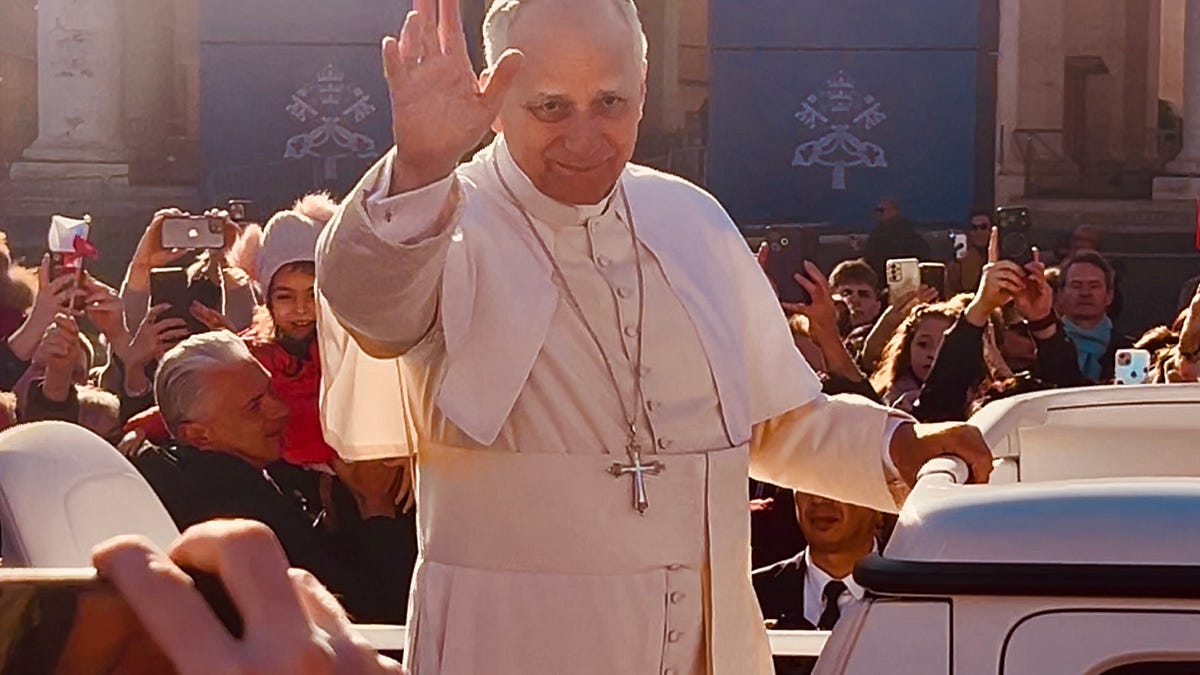
Pope Leo XIV confirmed on Monday the members of the Vatican’s Dicastery for Bishops, including the two women appointed by Pope Francis to the body — the first lay people to serve at the highest level for one of the most senior Vatican departments.
Of the three, Brambilla and Petrini also hold senior executive positions within the curia, serving as the prefect for the Dicastery for Institutes of Consecrated Life and Societies of Apostolic Life and head of the Vatican city state’s governing administration, respectively.
Since his election last year, Pope Leo has shown himself willing to unwind or reset some of his predecessor’s structural and administrative reforms of the curia — and even signaled a willingness to effectively pause the implementation of controversial laws.
Observers — especially canon lawyers —- have been waiting on whether the new pope would continue, or discontinue, Francis’ reform to allow lay men and women to serve in the highest curial positions, and Monday’s announcement about the composition of the Dicastery for Bishops would appear to be at least a partial signal of continuity.
Significantly, on the same day as the announcement of Brambilla’s appointment, official Vatican media carried a long article from the dicastery’s former prefect, Cardinal Marc Ouellet, in which the noted theologian argued that the openness of senior governance positions to the laity is an “ecclesiological advance,” not a “temporary concession.”
The timing of the two events seems improbably coincidental, and instead appears to indicate that Pope Leo intends to continue the broadening of lay involvement in Church governance, while at the same time articulating a more studied engagement with the Church’s sacramental theology and ecclesiology than was given in the Francis era.
The question now would seem to be whether Ouellet’s sense of “ecclesiological advance” has any natural and theological limits — and if so, where might they be drawn?
Underpinning some of Pope Francis’ more unconventional governing moves was a highly controversial decision to open up the most senior curial ranks in the Vatican to lay men and women.
Both before and after the 2023 promulgation of apostolic constitution Praedicate Evangeliium, canonists, theologians and Vatican commentators debated the theological significance of Francis’ move — with some favored papal advisors arguing for a previously out-of-favor school of ecclesiology, characterized by a kind of papal maximalism.
Cardinal Gianfranco Ghirlanda, SJ, a senior canonist and trusted Francis collaborator, publicly championed a vision of Church governance rooted entirely in the Petrine office.
According to Ghirlanda’s argument, governing authority in the Church is ultimately and immediately vested in the pope, who can delegate his authority to anyone he deems prudent — lay or ordained.
A papal mandate to govern, according to Ghirlanda, is the only qualification necessary to exercise any governance in the Church.
“The power of governance in the Church doesn’t come from the sacrament of Holy Orders, but from the canonical mission,” the cardinal argued in a Vatican press conference in 2022.
That statement, made in reference to the then recently promulgated Praedicate Evangeliium, triggered considerable pushback from canonists and theologians, including from Cardinal Ouellet, who was then prefect for the Dicastery for Bishops.
In an August 2022 edition of L’Osservatore Romano, Ouellet called Ghirlanda’s rationale “a Copernican revolution in the governance of the Church, not in continuity with or even going against the ecclesiological development of Vatican Council II.”
“As for the government of the Roman curia,” wrote Ouellet in the Vatican’s newspaper, “it is not enough to say that the canonical mission entrusted by the Holy Father is sufficient to establish the power of jurisdiction of every authority exercised in the dicasteries, be it the person designated cardinal, bishop, religious or lay person.”
To do so, said Ouellet, would perpetuate “a juridical mentality… which places the emphasis only on the delegation of power, without taking into account the charismatic dimension of the Church, which would go directly against the opening to authentic decentralization.”
Fast forward to 2026, and Cardinal Ouellet on Monday emerged with a very different conclusion from his earlier essay, but, curiously, with the same arguments he’d used previously.
In considering again “the charismatic dimension of the Church” and “authentic decentralization,” Ouellett appears to advance an argument toward the same ends as Ghirlanda did, offering an argument from theology, rather than a simple theory of power, for the prospect of lay ecclesiastical governance.
In his essay this week, Ouellet referred to his earlier critique of Cardinal Ghirlanda’s argument, noting that “The canonical justification that was presented when [Praedicate Evangeliium] was introduced did not meet with general approval, because it seemed to resolve a centuries-old controversy in a voluntaristic or arbitrary manner, by adopting a school position that the pope had taken to the detriment of prior dialogue with theologians and canonists.”
But without resiling from his previous criticisms, Ouellet went on to offer a theological endorsement of Francis’ innovation in governance — curiously using the same arguments with which he previously seemed to criticize it.
“There is still uncharted territory to explore in order to shed further light on Pope Francis’ prophetic gesture,” Ouellet wrote.
Asking whether Francis’ reforms to allow lay people to occupy the highest curial offices should be seen as “a temporary concession to be reviewed or an ecclesiological advance,” Ouellet concluded that “Pope Francis’ gesture is promising for the future, as it marks the beginning of recognition of the authority of charisms by hierarchical authority, in accordance with the guidelines of the Council, which invites pastors to ‘recognize in them (the laity) their ministries and charisms, so that all may cooperate to the best of their ability and with one heart in the common work’ [Lumen Gentium].”
“[Pope Francis] discerns the authority of the Holy Spirit at work beyond the link established between the ordained ministry and the government of the Church,” Ouellet wrote Monday. “There is no question of substituting charismatic governance for hierarchical government.”
Some canonists and theologians, however, will likely contend that such a question does exist — at least with regard to some aspect of ecclesiastical governance.
The Church says that bishops and others in positions of authority might exercise three kinds of functions, or munera, in the life of the Church — the offices of teaching, sanctifying, and governing, which flow from the authority given by Jesus Christ to his apostles, and their successors.
While the idea has always been important, Vatican II took special care to emphasize that bishops have a special share in those functions.
Lumen gentium, Vatican Council II’s dogmatic constitution on the Church, explained that “In his [episcopal] consecration a person is given an ontological participation in the sacred functions [munera]; this is absolutely clear from Tradition, liturgical tradition included.”
The Catechism of the Catholic Church puts this more simply: “Christ himself chose the apostles and gave them a share in his mission and authority.”
“Because it is joined with the episcopal order, the office of priests shares in the authority by which Christ himself builds up and sanctifies and rules his Body,” the Catechism explains.
This link between the sacrament of ordination and the exercise of governing power in the Church is also defined in the Code of Canon Law, which says that “Those who are constituted in the order of the episcopate or the presbyterate receive the mission and capacity to act in the person of Christ the Head.”
According to canon law, “those who have received sacred orders are qualified, according to the norm of the prescripts of the law, for the power of governance, which exists in the Church by divine institution and is also called the power of jurisdiction.”
While the Church talks about ordination and authority in a particular way, lay people can participate in the governing life of the Church as well. Lay people fill roles like that of the chancellor of a diocese, a promoter of justice (a canonical public prosecutor), and even as judges on canonical tribunals.
But the Church’s law defines their participation as “cooperation” in the power of governance, and the scope of that cooperating role is limited.
In response to these limiting arguments, Ouellet on Monday said that “sacramental theology suffers from a pneumatological deficit that goes hand in hand with a one-sided Christological vision. While it is true that the seven sacraments are acts of Christ, they are also acts of the Church resulting from the action of the Holy Spirit.”
In other words, according to Ouellet, to understand the Church’s exercise of governance as exclusively linked to sacramental orders — and therefore broadly exclusive of lay participation — is to have an imbalanced appreciation for the Trinitarian nature of God, who also acts in the Church through the Holy Spirit.
While Ouellet stressed that “there is no question of substituting charismatic governance for hierarchical government,” however, it is not exactly clear where the practical limits exist to ensure this is the case.
Cardinal Ouellet noted this week that he does not see scope for “entrusting [lay people] with tasks that are strictly sacramental in the Christological sense, but rather integrating their charisms into the service of the Holy Spirit, who presides over the communion of the Church in all its expressions.”
At the level of the Roman curia, Ouellet gives the examples of “the dicasteries dedicated to communication, the general government of the Vatican City State, the promotion of integral human development, life, the family and the laity, the promotion of religious charisms or societies of apostolic life,” all of which he says can “be directed by competent persons, lay or religious, with a charism recognized by the supreme authority.”
But some observers might ask, not unreasonably, what exactly the practical difference is between the theory of governance-by-papal-mandate held by Cardinal Ghirlanda, and the “charism recognized by the supreme authority” which Ouellet emphasized this week.
More to the point, while positively phrased, Ouellet’s articulation suggests that some curial leadership positions do not require ordination to be exercised, but allows that others do — though he does not offer a similar list of those departments.
The text of Praedicate Evangeliium also contains a similar tension. The constitution begins by offering a version of Ghirlanda’s argument for all power being delegated papal power, stating that “each curial institution carries out its proper mission by virtue of the power it has received from the Roman Pontiff, in whose name it operates with vicarious power in the exercise of his primatial munus.”
“For this reason, any member of the faithful can preside over a Dicastery or Office,” though the text then adds a qualifier: “depending on the power of governance and the specific competence and function of the Dicastery or Office in question.”
No canonical or theological objections have been raised to the work of dicasteries formerly designated as secretariats or pontifical councils, charged with topics like finance, communications, laity and family.
But other Vatican dicasteries previously constituted as congregations were so-termed because their membership was limited to clerics — faith, bishops, religious causes of saints, etc. It is not clear, nor clearly argued by Ouellet, which of these departments’ prefects would need the power of orders to occupy the position, and why or why not.
Ouellet, for example, argued in his Monday essay that lay religious have exercised a charism of governance over their particular religious communities for centuries, and including the Dicastery for Religious among those which could, ecclesiologically, be led by a lay person.
Given that dicastery is currently led by Sr. Simona Brambilla, Ouellet could hardly argue the contrary without questioning her legitimacy.
Ouellet’s essay, however, did not appear to be aimed at answering questions — he actually poses five of his own in a single paragraph — or settling the debate around lay governance at all.
For some Vatican watchers, it will be difficult to entertain seriously the idea that Ouellet’s sudden reemergence on the subject of lay governance on Monday was spontaneous.
While not every announcement by the Holy See is choreographed, it is hard to imagine that Ouellet’s essay was both spontaneously written, and coincidentally accepted for publication on the Vatican’s official news site to correspond with the announcement of Leo’s confirmation of three women to serve on the dicastery he once led.
Of course, the substance of Ouellet’s essay can be seen as parallel to the announcement of the dicastery’s renewed membership: there is a difference between lay involvement in the consultative or even collegially deliberative work of a body like the dicastery’s full membership, as opposed to the sole executive function of the office of prefect. Lay people have for years served as member-judges on judicial panels while being ineligible to act as sole judges, as clerics can.
But the more general debate about the scope and nature of lay governance in the Church, especially at the level of the Roman curia was and remains one of the more contentious debates of the Francis era.
Leo’s decision to broaden lay membership in the dicastery responsible for selecting bishops and when necessary prosecuting their actions under the norms of Vos estis lux mundi was always bound to resurface that debate — especially given it was Cardinal Prevost who succeeded Ouellet as prefect there.
Analysts have wondered since Leo XIV was elected how the new pope would resolve that debate: Would he press ahead with further senior lay appointments, or would he treat Francis’ reforms as, as Ouellet put it, “a temporary concession to be reviewed?”
Bambrilla’s appointment to serve alongside Petrini and Zervino seems to offer an answer to that question. But Ouellet’s essay, read as an intentional compliment to it, seems to suggest the answer is not simply a flat “yes” to lay people serving in any and all curial leadership roles.
To be clear, what Ouellet has done, seemingly with Leo’s approval if not at his direct invitation, is not to end the debate over lay governance, but reboot it entirely.
The cardinal’s assessment of the origins and nature of the power of governance in the Church has not noticeably changed since 2022, though his apparent conclusions appears completely reversed.
That apparent contradiction makes sense if one sees the real target of his 2022 interventions was not the idea of lay governance, even at the Vatican’s most senior levels, but the ecclesiology being used to rationalize it.
What Ouellet’s essay on Monday has done, perhaps, is reframe the debate away from the canonical positivism of Cardinal Ghirlanda and the Francis era, and towards a new, more theologically grounded consideration of the issue.
On the available evidence, it does not seem likely that Leo intends to sunset his predecessor’s precedent for senior lay appointments.
But it does appear that the new pope intends reforms to develop alongside a public discussion of their theological merits and limits, and away from an ecclesiology of “because I can.”
First Appeared on
Source link



Leave feedback about this