

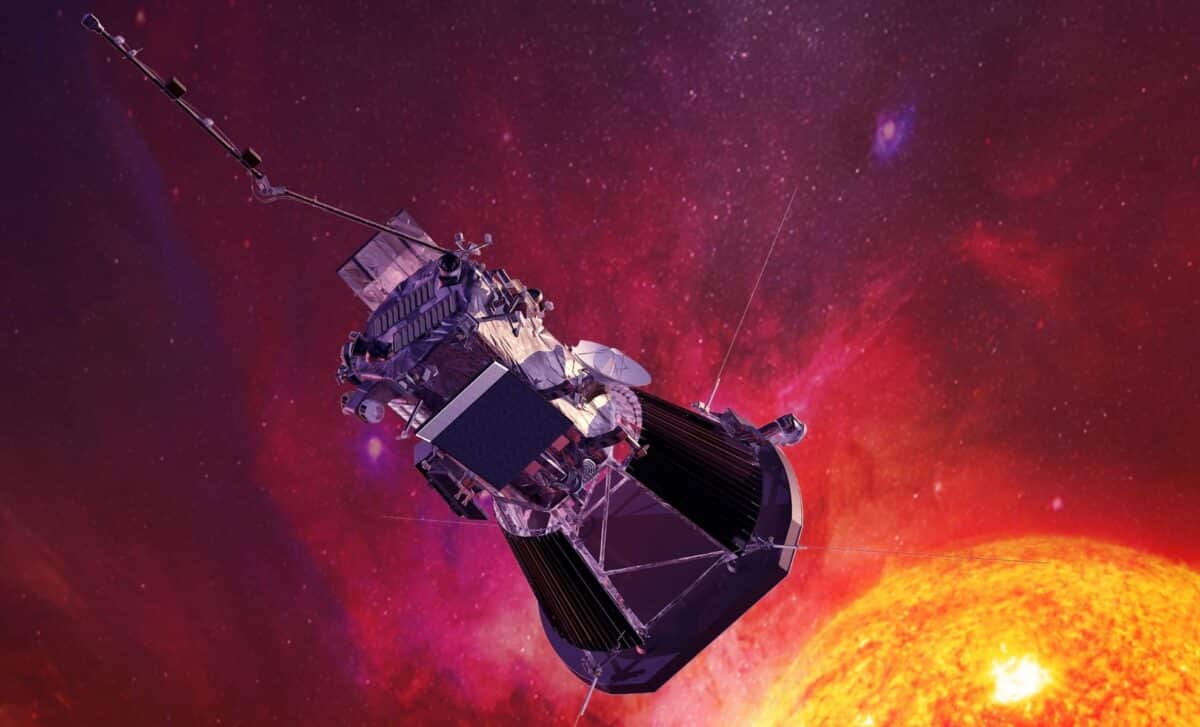
NASA’s Parker Solar Probe has completed a historic milestone by traveling closer to the Sun than any spacecraft before it. The groundbreaking data it has collected is offering new insights into the solar wind, a stream of charged particles that constantly flows from the Sun and impacts the entire solar system.
Since its launch in 2018, the Parker Solar Probe has been gathering detailed information about the Sun’s outer atmosphere, which had previously been out of reach for scientists. Its close proximity to the Sun has allowed researchers to study the solar wind in unprecedented detail, uncovering important information that could help protect Earth and its technology from space weather hazards.
The Parker Solar Probe: A Historic Mission to the Sun
Launched in 2018, NASA’s Parker Solar Probe was designed to make the closest-ever pass to the Sun and provide critical data on the solar wind. According to the study, published in Geophysical Research Letters, the probe’s recent closest approach was 3.8 million miles from the Sun’s surface. Using a unique flight path that involves multiple gravity assists from Venus, the Parker Solar Probe is revealing new details about the Sun’s activity and how it influences the surrounding space environment.
This mission is allowing scientists to chart the Sun’s outer boundaries and better understand how solar wind is created, accelerated, and heated. By measuring the Sun’s plasma environment up close, researchers are gathering data that will lead to more accurate models of solar phenomena.
Cracking the Solar Wind Heat Code
One of the most perplexing questions in solar science involves understanding the heating of the solar wind as it leaves the Sun’s surface. The Sun’s corona, or outer atmosphere, is millions of degrees hotter than its surface, which cools to around 10,000 degrees Fahrenheit. This unexpected heating process has long puzzled scientists, and the data from Parker Solar Probe is offering key insights into this phenomenon.
According to Kristopher Klein, an associate professor at the University of Arizona and lead researcher on the study, understanding how the solar wind gains energy as it moves outward is crucial to unraveling this mystery.
“We have made simplified models, we’ve run computer simulations, but by launching Parker Solar Probe and by doing these detailed calculations of the structure of the velocity distribution of the particles, we can improve those models and calculate actually how the heating occurs at these at these extremely close distances where we have never measured before.”
These detailed measurements could lead to a better understanding of solar wind dynamics, which could improve predictions of solar events and their impact on Earth.
🚨: NASA PROBE CAPTURED CLOSEST EVER IMAGES TO THE SUN, only 0.04 AU from the solar surface
NASApic.twitter.com/lZVMe1UF9K— Curiosity (@MAstronomers) February 3, 2026
First Appeared on
Source link





Leave feedback about this