

When you buy through links on our articles, Future and its syndication partners may earn a commission.
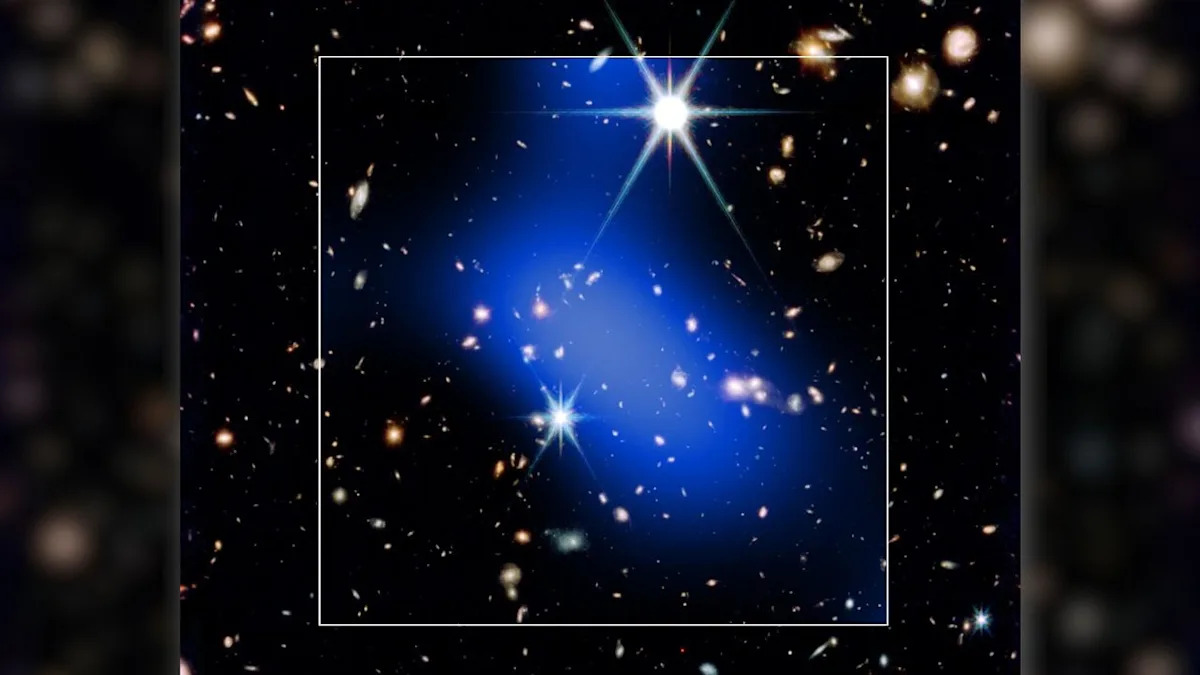
The large protocluster JADES-ID1, as seen by the James Webb Space Telescope (background) and Chandra X-ray Observatory (blue). | Credit: X-ray: NASA/CXC/CfA/Á Bogdán; Infrared: NASA/ESA/CSA/STScI; Image Processing: NASA/CXC/SAO/P. Edmonds and L. Frattare
QUICK FACTS
What it is: A young cluster of galaxies, JADES-ID1
Where it is: 12.7 billion light-years from Earth
When it was shared: Jan. 28, 2026
This stunning image showcases what astronomers think is the most distant galaxy protocluster ever found, and it holds a very important clue about the history of the universe.
Located 12.7 billion light-years away from Earth, the protocluster, dubbed JADES-ID1, appears in this image as a collection of glowing dots and specks embedded within a large blue cloud.
A protocluster is simply a galaxy cluster in its infancy. It is a region with a large number of young galaxies that are being pulled together by gravity, contained within a large cloud of hot gas. Galaxy clusters are vast collections of hundreds to thousands of galaxies that are held together by gravity, and a protocluster essentially shows how such a large structure forms and grows.
However, in protoclusters, galaxies are not as tightly bound together as they are in mature galaxy clusters. Additionally, the surrounding hot gas that usually makes clusters easy to spot is not developed enough to emit detectable X-rays. Therefore, detecting a protocluster is challenging.
Scientists discovered JADES-ID1using the deepest observations from two powerful telescopes: the Chandra X-ray Observatory and the James Webb Space Telescope (JWST). JWST’s infrared instruments detected at least 66 galaxies held together by gravity in this region. Because JADES-ID1 possessed enough mass to heat its surrounding gas to very high temperatures, Chandra detected the X-ray emissions from the large cloud of hot gas that contains all these galaxies. This provided further evidence that these galaxies are part of a single entity.
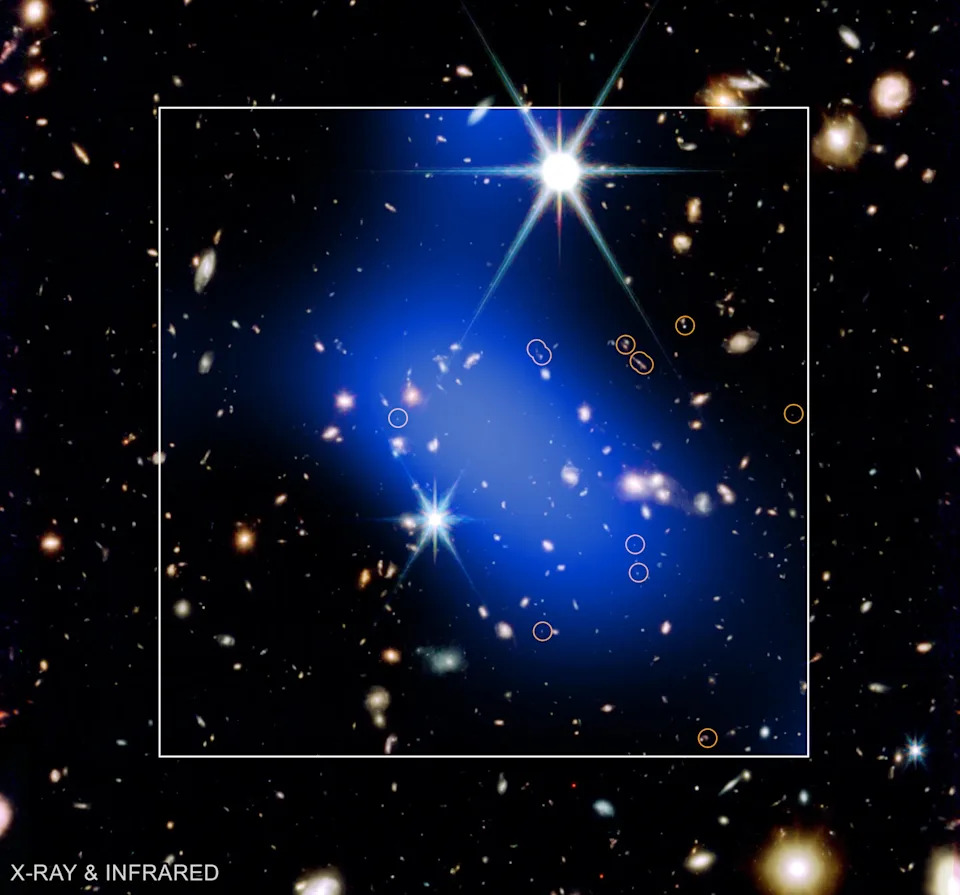
Another version of the protocluster image with individual galaxies circled. | Credit: X-ray: NASA/CXC/CfA/Á Bogdán; Infrared: NASA/ESA/CSA/STScI; Image Processing: NASA/CXC/SAO/P. Edmonds and L. Frattare
In the annotated version of the image, some of the individual galaxies identified by JWST’s infrared observations are circled. The neon blue region represents the hot gas detected in X-rays by Chandra.
A real puzzle surrounding this discovery is its place on the timeline of the history of the universe. Astronomers found that JADES-ID1 has the mass of 20 trillion suns and spans about 1.1 million light-years across. Most models of the universe predict that a protocluster this massive should not form until between 2 and 3 billion years after the Big Bang. However, surprisingly, JADES-ID1 is estimated to have existed when the universe was only about one billion years old.
“This may be the most distant confirmed protocluster ever seen,” lead author of the study Akos Bogdan of the Harvard & Smithsonian Center for Astrophysics (CfA), said in a statement. “JADES-ID1 is giving us new evidence that the universe was in a huge hurry to grow up.”
RELATED STORIES
—Every major galaxy is speeding away from the Milky Way, except one — and we finally know why
—James Webb telescope discovers closest galaxy to the Big Bang ever seen
—Giant rotating string of galaxies is ‘probably the largest spinning object’ in the known universe
Astronomers are now curious about how this protocluster formed so quickly. That’s because, according to current models, there wouldn’t have been enough time or enough galaxies in the first billion years of the universe for a protocluster of such a size to come together.
The study was published Jan. 28 in the journal Nature.
For more sublime space images, check out our Space Photo of the Week archives.
First Appeared on
Source link



Leave feedback about this