

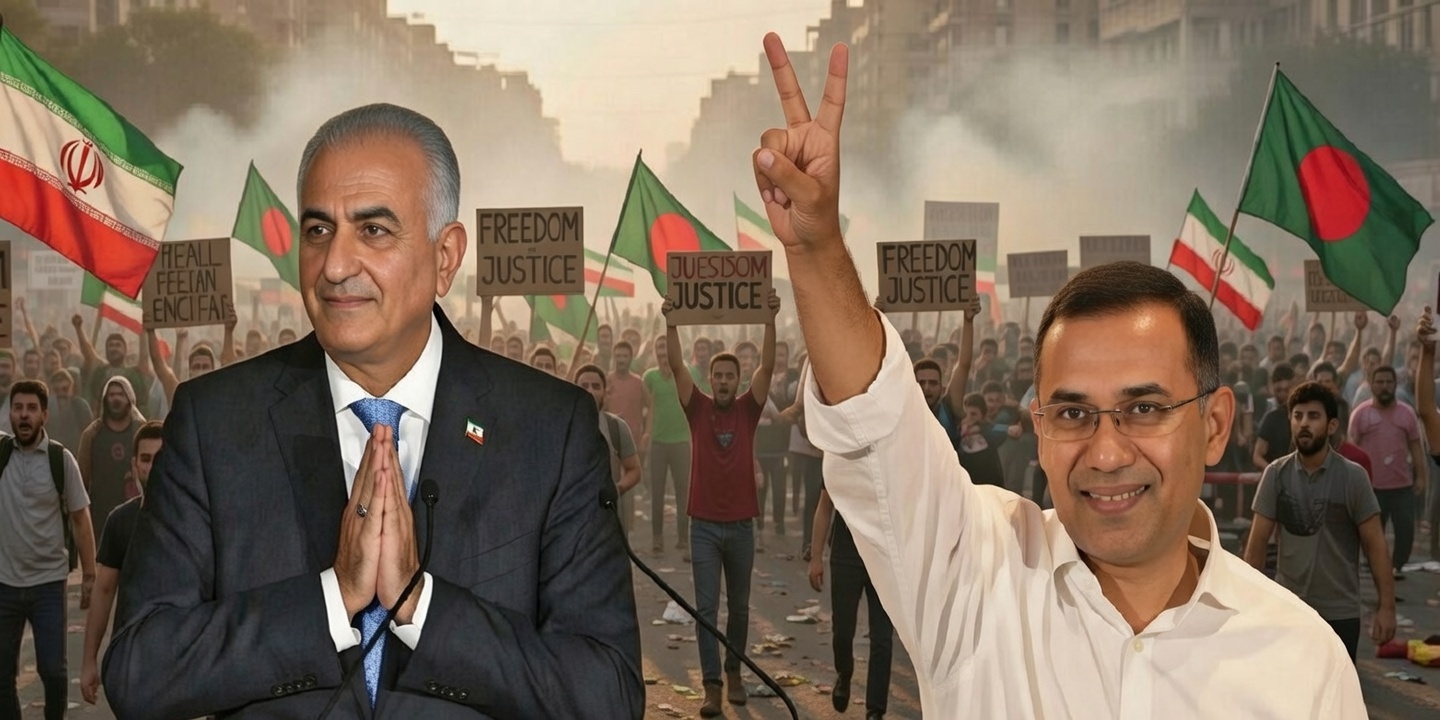
From an exiled politician living in London for the last 17 years, to suddenly the Prime Minister of Bangladesh, Tarique Rahman’s fortunes have changed in just two months.
Bangladesh Nationalist Party (BNP) chief Rahman, 60, the scion of one of the most powerful political dynasties, will lead the country’s 170 million people after sweeping elections!
It must be noted that BNP managed to “sweep” the elections after the biggest and ruling political party, Awami League, was banned after the removal of then-PM Sheikh Hasina due to “student uprising.”
“This victory belongs to Bangladesh, belongs to democracy,” Rahman said in his first speech since the vote. “This victory belongs to people who aspire to and have sacrificed for democracy.”
The success of BNP supremo marks a stunning comeback for a man who only returned to Bangladesh in December after 17 years in exile in the UK. The BNP alliance won 212 seats, compared with 77 for the Jamaat-e-Islami-led alliance.
Tarique Rahman, the elder son of former President Ziaur Rahman and former Prime Minister Khaleda Zia, was long viewed as the heir to the BNP.
His political fortunes crashed after his mother’s government fell in 2007 amid military intervention. Facing corruption charges, Rehman went into exile in London in 2008. Convicted in absentia on multiple counts, he appeared sidelined for over a decade.
The so-called 2024 student-led uprising that toppled then-PM Sheikh Hasina changed everything. As Hasina fled to India, the interim government under Muhammad Yunus paved the way for fresh elections, sans Hasina and the Awami League.
Rahman returned quietly in late December 2025, was quickly cleared of all charges, and immediately galvanised the BNP base. His campaign promised “Bangladesh First,” economic revival, better governance, and national unity.
With the Awami League banned, the BNP was the favourite to win. Hasina, 78, who was sentenced to death in absentia for crimes against humanity, issued a statement from India decrying an “illegal and unconstitutional election”.
In his “victory speech”, Rahman said, “Our paths and opinions may differ, but in the interest of the country, we must remain united.” He has prioritised restoring the economy, law and order, and democratic institutions damaged under Hasina’s long rule.
His father, President Ziaur Rahman, was assassinated in 1981, while his mother, Khaleda Zia, served two terms as prime minister.
Earlier on Saturday, retiring interim leader, Nobel laureate Muhammad Yunus, said Rahman “would help guide the country toward stability, inclusiveness, and development”.
The US embassy congratulated Rahman and the BNP for a “historic victory”, while neighbouring India praised his “decisive win,” a sign of diplomatic courtesy with the aim of stabilizing deteriorating India-Bangladesh ties.
International election observers said the polls had been a success, with the European Union calling them “credible”. The Election Commission said turnout was 59 percent across 299 constituencies out of 300 that held voting.
Voters also endorsed, in a referendum, a sweeping democratic reform charter backed by Yunus to overhaul what he called a “completely broken” system of government and to prevent a return to one-party rule.
Those include term limits for the prime minister, a new upper house of parliament, stronger presidential powers, and greater judicial independence.
But Rahman said the new government he will lead faces daunting challenges. “We are about to begin our journey in a situation marked by a fragile economy left behind by an authoritarian regime, weakening constitutional and structural institutions.”
Reza Pahlavi Watching?
Across the region, another exiled prince is watching closely – and acting boldly. Reza Pahlavi, the Crown Prince of Iran and son of the last Shah, has spent nearly five decades in the United States.
The exiled son of Iran’s last shah said he was ready to lead the country to a “secular democratic future” at a rally in Munich on Saturday, after US President Donald Trump said a change of power would be the “best thing”.
It came as Washington continued to engage diplomatically with Tehran’s government, with Switzerland on Saturday confirming that mediator Oman would host a fresh round of talks in Geneva next week.
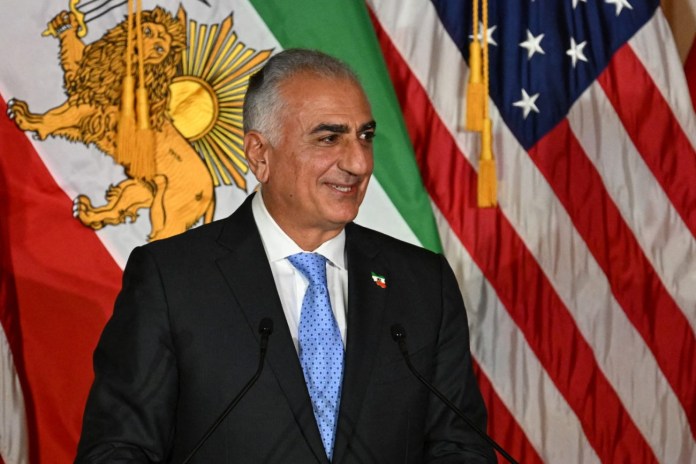
US-based Reza Pahlavi, who has not returned to Iran since before the 1979 Islamic revolution that ousted the monarchy, told his supporters, who gathered in the thousands, that he could lead a transition. “I am here to guarantee a transition to a secular democratic future,” he said.
“I am committed to be the leader of transition for you so we can one day have the final opportunity to decide the fate of our country through a democratic, transparent process to the ballot box.”
“Javid Shah” (long live the Shah), the crowd chanted as they waved green-white-and-red flags with a lion and a sun — the emblem of the toppled monarchy.
“The Iranian regime is a dead regime,” a 62-year-old protester originally from Iran who gave his name only as Said told AFP. “It must be game over.”
Pahlavi has urged Iranians at home and abroad to continue demonstrating, calling on them to chant slogans from their homes and rooftops at 8:00 pm (1630 GMT) Saturday and Sunday, to coincide with protests in Germany and elsewhere.
Thousands of protesters, in demonstrations from downtown Los Angeles to the National Mall in Washington, marched in solidarity with anti-government protests in Iran on Saturday.
“To President Trump… The Iranian people heard you say help is on the way, and they have faith in you. Help them,” Pahlavi had earlier told reporters gathered at the Munich Security Conference. “It is time to end the Islamic Republic,” he said.
Pahlavi had encouraged Iranians to join the wave of protests, which Iranian authorities have said were hijacked by “terrorists” fuelled by their sworn enemies, the United States and Israel.
Many protest chants had called for the monarchy’s return, and Pahlavi, 65, has said he is ready to lead a democratic transition.
Reza Pahlavi’s exile began in 1978, when he was just 17. The Islamic Revolution swept away his father’s monarchy, forcing the Pahlavi family into a life of quiet exile. For decades, he was dismissed by many as a symbolic figure just like Rehman – a relic of a bygone era.
But the ground beneath the Islamic Republic has been shifting for years. Economic woes, brutal crackdowns on protests (from the 2022 Mahsa Amini uprising to the latest wave in late 2025), and a string of regional setbacks have eroded the regime’s legitimacy.
Interestingly, before sweeping to power in Tehran in 1979 and changing the future of Iran and the wider Middle East, Ayatollah Ruhollah Khomeini had spent nearly 15 years in exile in France.
Khomeini left Iran in November 1964 to avoid imprisonment after repeatedly opposing the Shah’s policies.
He spent the next 15 years in Iraq, Turkey, and France, issuing sermons from these countries and mobilizing his supporters to oppose the Shah’s regime. He returned to Iran in February 1979, after the Iranian Revolution.
Now, 47 years later, will history repeat itself? This time, it’s the Shah’s son, Reza Pahlavi, in exile, and Iran’s current Supreme Leader, Ali Khamenei, trying to save his theological regime.
Pahlavi has tried to capitalise on the anti-regime protests. In recent months, he has outlined a clear roadmap: a transitional government, a referendum on the future system, and elections for a new parliament.
Striking Similarities
The similarities are striking. Both Rahman and Pahlavi were forced into exile and remained out of active politics for over a decade. Both of them have been living in exile but are now being used to replace governments deemed hostile to the West.
The similarities are striking. Both Rahman and Pahlavi were forced into long-term exile—Rahman for 17 years in the UK, Pahlavi for nearly five decades in the US—and remained largely sidelined from active politics in their home countries.
Now, amid domestic upheavals and troubled relations with the West, both have reemerged as symbols of change: Rahman through a decisive mandate in Bangladesh, and Pahlavi by rallying opposition voices and appealing for international backing to quicken regime transition in Iran.
But Iran is not Bangladesh!
Bangladesh’s transition was quick: a student revolt, an interim government, and credible elections. Iran’s path is far more complicated.
The Islamic Revolutionary Guard Corps (IRGC) remains a tough nut to crack. If Reza wants to lead Iran, American military intervention is a must. Whether that will lead to a regime change in Tehran is questionable.
Still, the momentum is building. Protests continue in Iran despite internet blackouts and a crushing response by the Islamic regime in Tehran.
The Big Question: Tarique Rahman has proven that exile is not permanent. From a London apartment to the Prime Minister’s office in under two months – it’s a turn of fortunes for Rehman.
Can Reza Pahlavi do a Tarique Rahman in Iran?
As Pahlavi told supporters in Munich: “The battle in Iran today is between occupation and liberation.” History is full of exiled leaders who returned at the right time – from Charles de Gaulle to Nelson Mandela to, now, Tarique Rahman.
Whether Pahlavi will be included on the “elite list” may depend on how Iran negotiates with the Trump administration.
First Appeared on
Source link



Leave feedback about this