

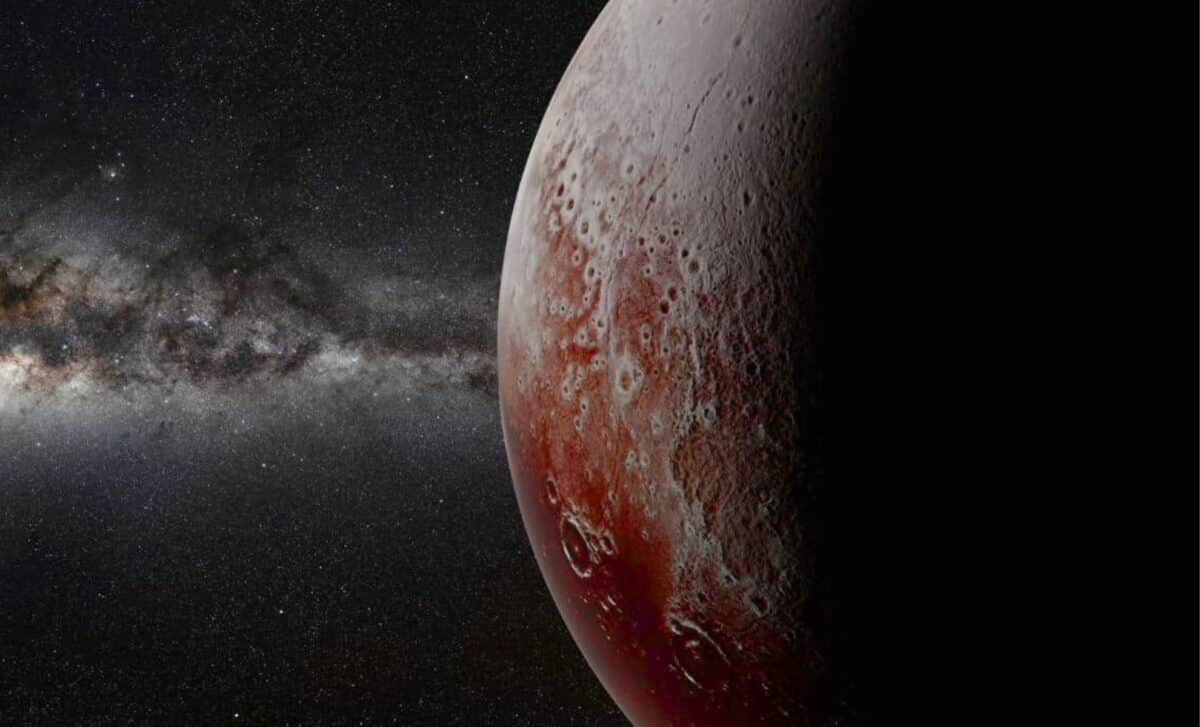
For fifteen years, it gave nothing away. Every observation returned the same blank signal, a featureless spectrum that resisted every attempt to read its composition. Astronomers pointed the Hubble Space Telescope at it, then ground based observatories, then more instruments, and still the planet kept its secrets behind layers of haze so thick that light could not carry information about what lay beneath.
The planet designated GJ 1214 b orbits a small red star 47 light years from Earth, completing one circuit every 38 hours. It is the most favorable target in its class for atmospheric study, a sub Neptune world of a type that dominates the galaxy but has no counterpart in our own solar system. And until the James Webb Space Telescope turned its infrared instruments toward it in 2023, the planet might as well have been a solid sphere for all that spectroscopy could reveal.
What Webb found has forced a reclassification. The atmosphere contains carbon dioxide and methane, gases masked for years by persistent high altitude aerosols. The combination of a thick, hazy envelope with the chemistry of a runaway greenhouse world has led researchers to propose an entirely new category: super Venus, a classification now associated with the planet some call Enaiposha.
A Signal Buried in Haze
Discovery came in 2009 when the MEarth Project detected the planet transiting its host star, an M dwarf later designated GJ 1214. The planet’s radius of 2.7 Earths and mass of 8.2 Earth masses placed it in a category that appears in Kepler and TESS data with striking frequency. These sub Neptunes, worlds between 1.0 and 3.9 Earth radii, simply do not exist in our solar system.
The planet became a priority target for atmospheric characterization. Its large atmosphere relative to the small host star meant that transmission spectroscopy, the technique of analyzing starlight filtered through the planetary limb during transit, should reveal molecular signatures with relatively modest observation time. The Transmission Spectroscopy Metric ranked GJ 1214 b highest among all known sub Neptunes.
Yet observation after observation returned flat. Hubble’s Wide Field Camera 3 produced featureless spectra. Ground based instruments at multiple observatories saw nothing. The planet’s atmosphere, researchers concluded, must be enshrouded in high altitude aerosols or photochemical hazes that scatter light uniformly across wavelengths, erasing the molecular fingerprints that would otherwise reveal composition.
Piercing the Obscuring Layer
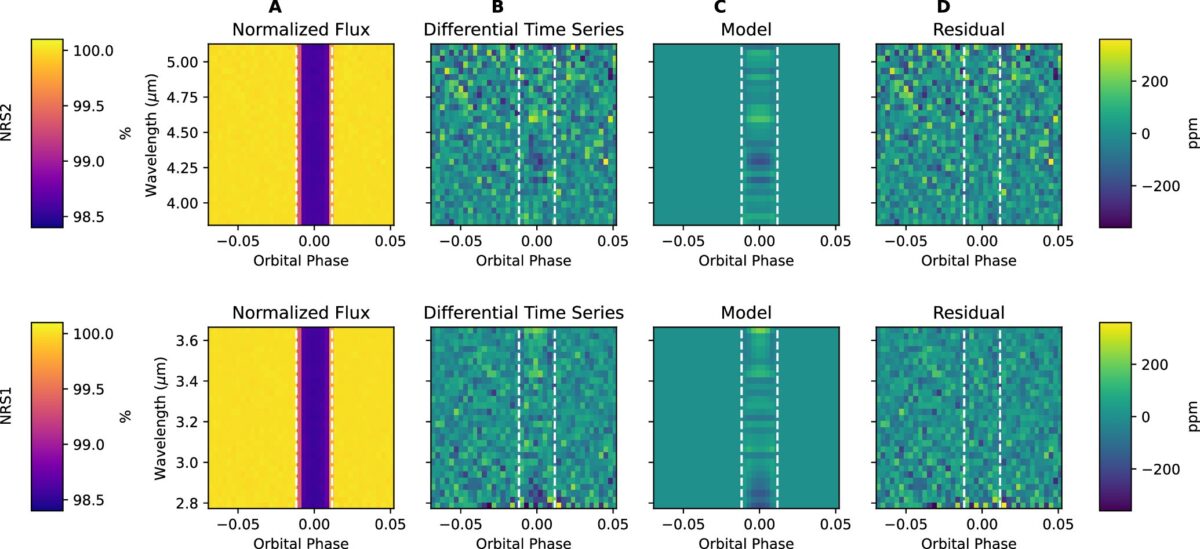
The James Webb Space Telescope’s Near Infrared Spectrograph observed GJ 1214 b during two consecutive transits beginning July 18, 2023. The instrument collected data across the 2.8 to 5.1 micron wavelength range. Two independent analysis pipelines processed the raw data, each designed to extract transmission spectra while accounting for instrumental effects and stellar variability.
Both pipelines returned the same result. The spectrum showed absorption features consistent with carbon dioxide and methane. A model containing both molecules was preferred over a featureless spectrum at 3.3σ significance by one pipeline and 3.6σ by the other. The peer reviewed findings, published in The Astrophysical Journal Letters, represent the first successful spectroscopic analysis of this long obscured atmosphere.
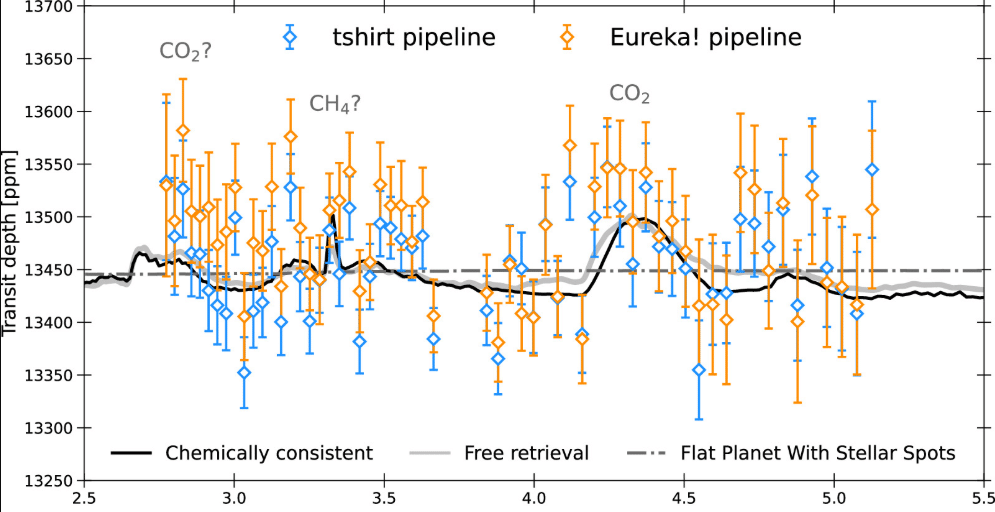
“The detected CO2 signal from the first study is tiny, and so it required careful statistical analysis to ensure that it is real,” Kazumasa Ohno, a researcher at the National Astronomical Observatory of Japan and coauthor of the study, said in subsequent reporting.
Why Venus Provides the Closest Analog
The combination of a thick, hazy atmosphere with detectable carbon dioxide distinguishes GJ 1214 b from other sub Neptunes that have been characterized and from the solar system’s ice giants. Uranus and Neptune possess high metallicity atmospheres, estimated at approximately 80 times solar abundance, but their aerosol layers do not produce the uniform spectral masking observed in GJ 1214 b prior to Webb.
Venus presents a different analog. The planet’s dense carbon dioxide atmosphere, sulfuric acid clouds, and extreme greenhouse effect create conditions that, while different in scale, share structural features with what Webb detected. The term super Venus captures both the qualitative similarity and the quantitative difference in scale.
The carbon dioxide detection carries specific implications for atmospheric metallicity. Reproducing the observed CO2 abundance requires atmospheric enrichment to levels exceeding 100 times solar, higher than Uranus and Neptune and substantially higher than the solar composition gas giants. Such enrichment points to formation under conditions that delivered large quantities of solid material into the planetary envelope after the main accretion phase.
Methane’s presence alongside carbon dioxide imposes additional constraints. At the temperatures expected in GJ 1214 b’s atmosphere, approximately 600 K equilibrium temperature, methane and carbon dioxide should not coexist in thermochemical equilibrium. Carbon prefers CO at these temperatures. The detection of both molecules therefore implies either disequilibrium processes such as photochemistry or vertical mixing that transports species from different atmospheric layers.
What Remains to be Seen
The research team’s published findings emphasize the preliminary nature of the detection. The signal to noise ratio, while sufficient for statistical significance, remains low enough that confirmation requires additional observation. Future programs could target multiple transits to build signal, or could employ different instrument modes to access complementary wavelength regions where other molecular species might leave detectable signatures.
The NIRSpec data alone cannot distinguish between multiple possible atmospheric structures that could produce the observed spectrum. Different combinations of temperature profiles, metallicity, and aerosol properties can fit the current data within uncertainties. Additional observations at shorter or longer wavelengths would break some of these degeneracies by providing leverage on different molecular absorption bands.
Complementary constraints come from the MIRI phase curve observations published separately. Those data required atmospheric metallicity above 100 times solar to explain the measured day night temperature contrast and showed molecular absorption consistent with water vapor in the dayside and nightside emission spectra.
First Appeared on
Source link






Leave feedback about this