

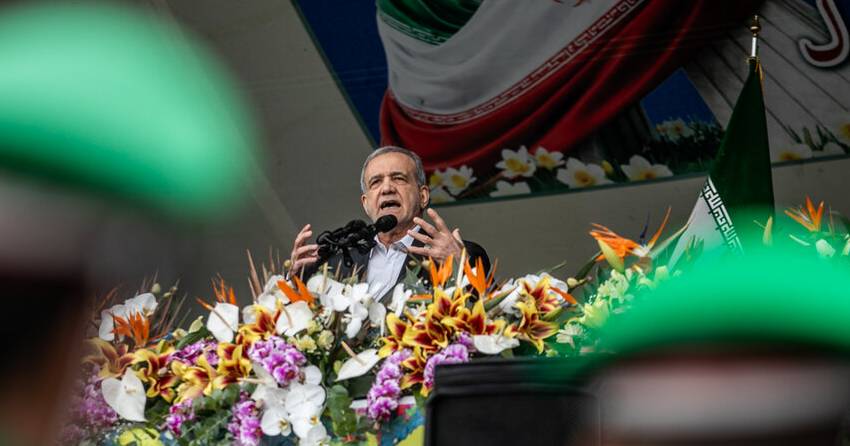
The annual commemoration of the 1979 Islamic Revolution has long served as a showcase of mass loyalty. This year, however, it unfolded under the shadow of what critics describe as a deepening crisis of legitimacy following the January bloodshed.
In Tehran, security forces and Basij units maintained a visible presence as supporters gathered in Azadi Square. State media broadcast images of families and children waving flags, and highlighted what it portrayed as festive participation across the country.
Among the more striking displays were symbolic coffins bearing the names and photos of senior US military officials, including US Army Chief of Staff Randy George and CENTCOM Commander Brad Cooper. Cooper was part of the US delegation that recently held talks with Iranian officials in Oman.
American and Israeli flags were also burned during the rally.
The imagery of defiance came as Iranian officials engage in renewed diplomatic contacts with the United States. The juxtaposition reflected a dual message: confrontation abroad and consolidation at home.
President Masoud Pezeshkian, addressing the rally, repeated the government’s narrative about the recent unrest, accusing protesters of sabotage and violence and saying “no Iranian takes up arms to kill another Iranian.”
He acknowledged widespread dissatisfaction but said the government was prepared to “hear the voice of the people,” while emphasizing loyalty to Supreme Leader Ali Khamenei and adherence to his “red lines” in diplomacy, a tacit reference to Iran’s uranium enrichment, missile program and support for regional militia groups.
State television placed particular emphasis on images of children and families at the rallies, a move that analysts say may reflect efforts to soften the government’s image after weeks of reports about civilian casualties.
Rights advocates have long criticized the use of minors in political events, arguing that it instrumentalizes children for propaganda purposes.
The commemorations took place roughly a month after a violent suppression of protests that erupted in late December.
The editorial board of Iran International said earlier this month that more than 36,500 people had been killed in a targeted crackdown ordered by Khamenei.
Even as the government staged its anniversary spectacle, dissent surfaced in other forms. On the eve of 22 Bahman, residents in multiple neighborhoods of Tehran – including Narmak, Ekbatan, Majidieh and Naziabad – shouted slogans such as “Death to Khamenei” and “Death to the dictator” from rooftops and balconies. Similar chants were reported in cities including Mashhad, Arak, Qazvin, Kermanshah and Shahriar.
Videos circulating online showed nighttime fireworks lighting the sky as anti-government slogans rang out.
In one clip from Arak, residents could be heard chanting against Khamenei in response to mosque loudspeakers broadcasting the traditional “Allahu Akbar.”
In Tehran, one resident said the fireworks were so loud “we thought America had attacked.”
In isolated incidents, pro-government speakers appeared to inadvertently repeat anti-Khamenei slogans during live broadcasts, prompting abrupt cuts in coverage.
One state reporter in Sistan and Baluchestan was heard listing “Death to Khamenei” among rally chants before the feed was interrupted.
Political analyst Iman Aghayari told Iran International that the anniversary had become “an arena of confrontation between the government and the people,” adding that unlike in previous years, authorities seemed less concerned with demonstrating broad public backing and more focused on asserting control.
“This time,” he said, “the regime is not trying to prove people are with it. It is simply declaring that it rules.”
As Iran navigates renewed diplomacy abroad and mounting pressure at home, the 22 Bahman (February 11) anniversary appeared to reflect a widening gap between official displays of unity and the anger that continues to surface beyond the state’s stage-managed events.
First Appeared on
Source link



Leave feedback about this