

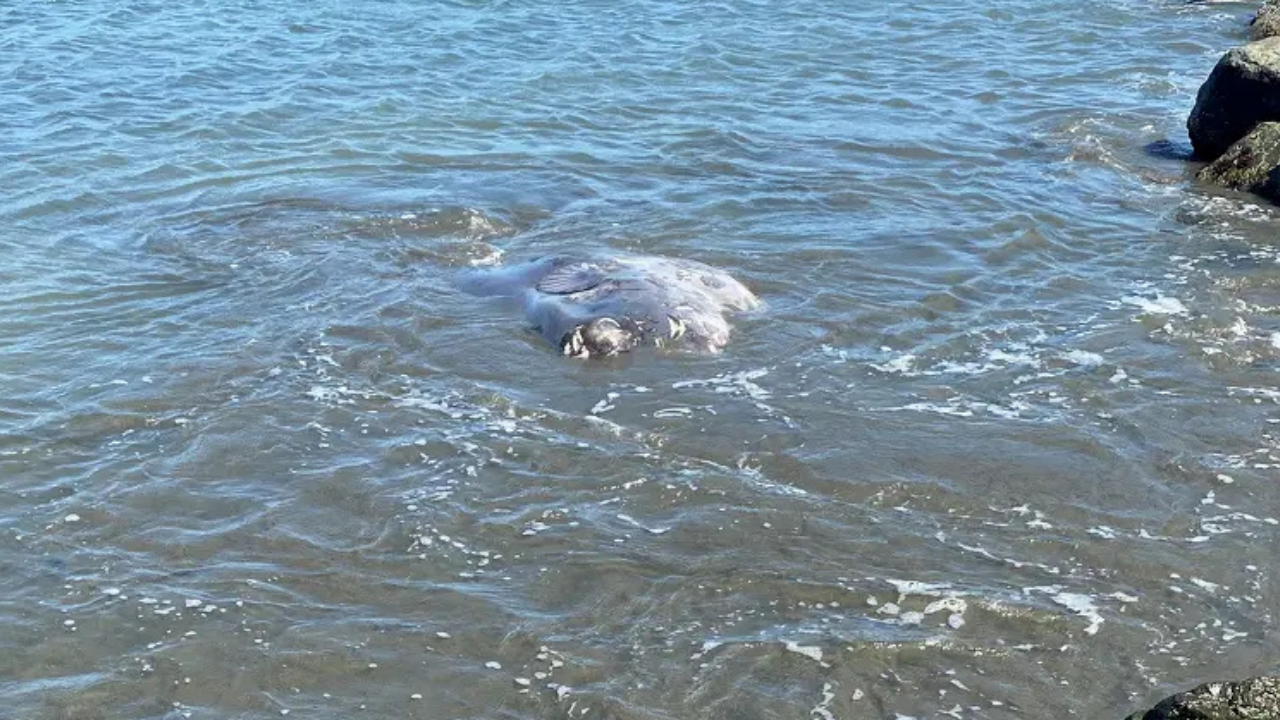
On a wind-brushed Sunday in Northern California, a routine beach cleanup yielded a breathtaking surprise: one of the planet’s rarest marine animals lay still on the sand. The discovery, made by novelist and Sonoma State University professor Stefan Kiesbye at Bodega Bay’s Doran Regional Park, turned a quiet morning into scientific intrigue. What he found was not a sea lion, but a seldom-seen sunfish that challenges where such giants roam.
A quiet cleanup turns extraordinary
Kiesbye spends his Sundays removing trash from local shores, listening to the chorus of sea lions and scanning the tideline. As he walked toward the western edge of Doran Beach, the scene shifted from routine to remarkable. Resting on the sand was an enigmatic creature, a slab-like silhouette unlike any stranded pinniped he’d seen before.
A deceptive sunfish revealed
The fish measured roughly six feet long and three feet across, an imposing presence even in stillness. Experts later identified it as Mola tecta, the “hoodwinker” sunfish, among the world’s rarest marine species. First described in 2017 by researchers in New Zealand, this elusive fish can grow to immense sizes, with some sunfish relatives tipping the scales at two tons. The encounter offered a rare window into a species that has spent much of modern science hiding in plain sight.
How it differs from common relatives
The hoodwinker is often confused with Mola mola, the more familiar ocean sunfish. But careful eyes reveal key differences: a smoother, sleeker body, no protruding snout, and none of the head or “chin” bumps typical of adult Mola mola. As sunfish specialist Dr. Marianne Nyegaard has noted, these traits help distinguish the hoodwinker from its better-known cousin. “We know that Mola tecta is present in the Humboldt Current off South America, up to Peru in the north, but we didn’t think they crossed the warm equatorial belt, at least not very often,” she said. Her observation underscores just how surprising this sighting truly is.
A sighting that redraws the map
Finding a hoodwinker on a Californian beach pushes against long-held expectations about its range. For years, scientists believed the species remained in the Southern Hemisphere, tracing cool currents and productive waters. Yet ocean life often ignores the lines drawn on our maps, and rare strandings can function like breadcrumbs, hinting at migrations we barely understand. This solitary fish suggests pathways that loop across basins, through currents like Humboldt, and possibly past equatorial thresholds.
Why do sunfish strand?
Sunfish strandings happen around the world, but the cause is still unclear. Some researchers point to shifting currents, sudden storms, or disorientation during foraging near the surface. Others consider injuries, parasites, or collisions with vessels, all of which can weaken large pelagic fish. As Dr. Nyegaard has emphasized, “We hope to know more one day about why this happens,” capturing both the mystery and the urgency of ongoing research.
Clues from the shoreline
Even a single stranding can carry data: size, condition, and precise location feed into distribution maps and genetic studies. Strandings also invite public participation, as beachgoers increasingly become the first observers. When documented responsibly, these moments help scientists refine hypotheses about movement, behavior, and environmental change.
- Record the exact location and time, using your phone’s GPS if possible.
- Keep a respectful distance and do not touch the animal.
- Contact local wildlife authorities or a regional stranding network.
- Photograph key features from several angles to aid later identification.
- Do not attempt to push the animal back to sea; trained responders must assess its condition first.
What this means for our understanding of the ocean
Encounters like this one remind us how much ocean life remains unmapped and misunderstood. A fish that eluded formal description until 2017 is now rewriting its own atlas by washing ashore far from presumed haunts. Such events prod scientists to revisit assumptions, refine models, and expand surveys into overlooked waters. They also challenge all of us to treat the shoreline as a living laboratory, where careful observation can lead to discovery.
A quiet marvel with global echoes
On that September morning, a beach cleanup became a bridge between daily stewardship and cutting-edge science. The hoodwinker’s broad form and cryptic history turned a simple walk into a story about currents, climate, and the reach of living maps. In a world where the sea remains our largest frontier, even a still fish on wet sand can carry a message that spans hemispheres. And while the ocean keeps many secrets, each rare arrival nudges us closer to understanding the forces that shape our blue planet.
First Appeared on
Source link






Leave feedback about this