

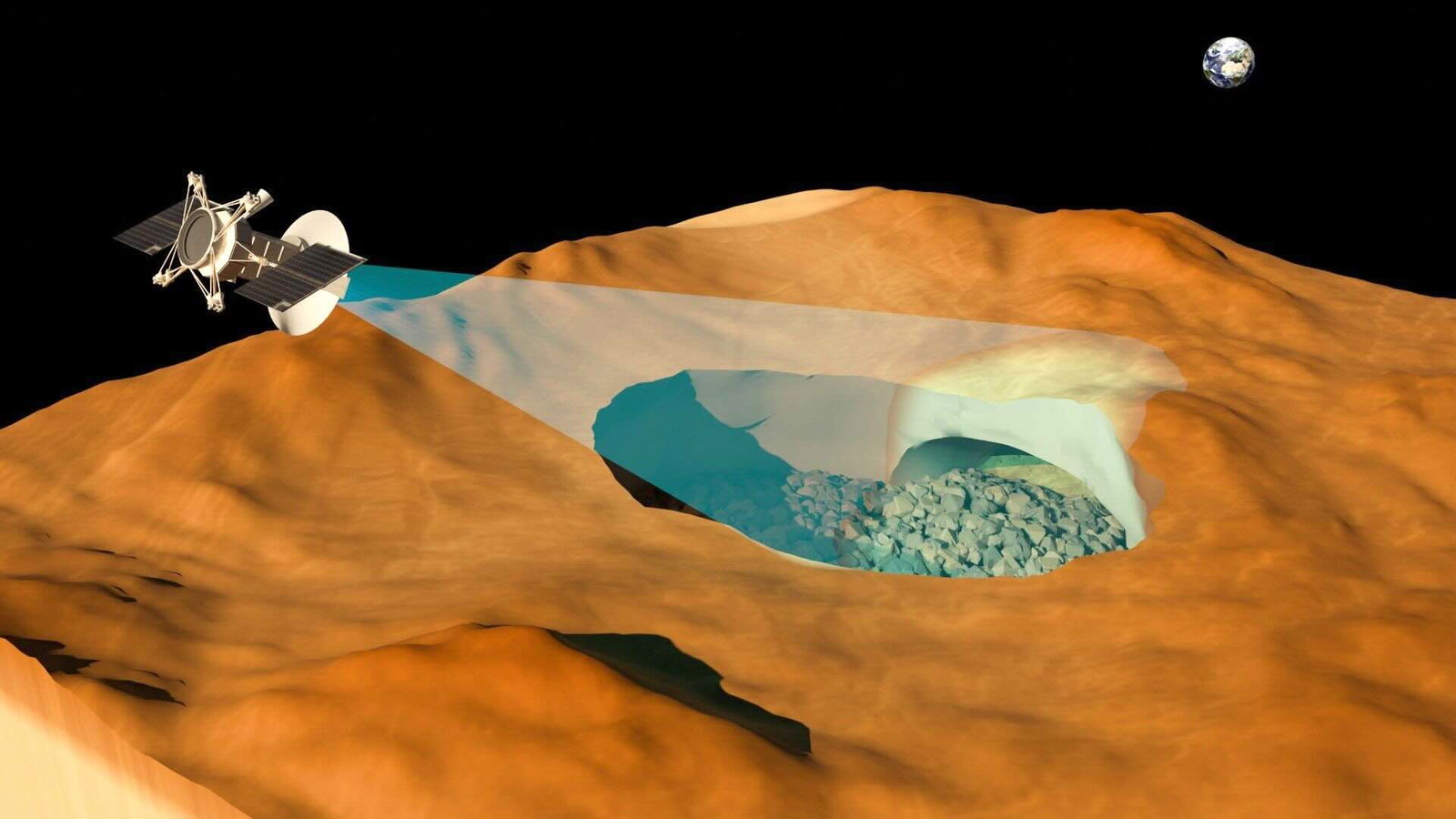
A massive subsurface structure has been discovered on Venus, according to astronomers relying on radar data analysis.
The large underground feature is believed to be a remnant of ancient volcanic activity that once proliferated on the nearby planet. In the past, similar evidence of ancient lava tubes has been discovered on both the Mars, and even on Earth’s moon.
The findings, reported by astronomers with the University of Trento in the journal Nature Communications, say their discoveries are shedding new light on the geology that shaped Venus through volcanic activity over time.
Lorenzo Bruzzone, who coordinated the recent research, said that this represents the first opportunity astronomers have had to glimpse such processes occurring beneath Venus’s surface.
“Our knowledge of Venus is still limited, and until now we have never had the opportunity to directly observe processes occurring beneath the surface of Earth’s twin planet,” Bruzzone said in a statement. “The identification of a volcanic cavity is therefore of particular importance, as it allows us to validate theories that for many years have only hypothesized their existence.”
A full professor of Telecommunications and head of the Remote Sensing Laboratory at the Department of Information Engineering and Computer Science of the University of Trento, Bruzzone says the discoveries he and his colleagues have made contribute significantly to our understanding of “the processes that have shaped Venus’s evolution and opens new perspectives for the study of the planet.”
Extraterrestrial Lava Tubes
One of the major hurdles to making such discoveries is the difficulty of locating subsurface features on planets other than Earth. Naturally, lava tubes and other hollow structures located beneath a planet’s surface remain invisible to not only the eye, but also a range of remote detection capabilities.
However, there are instances in which such features can be revealed. If thin portions of a planet or moon’s surface located above subsurface cavities caves in, it can sometimes reveal the empty conduit below. Such conditions have led to several discoveries of what are referred to as “skylights” on the lunar surface, indicating the lava tubes below.
However, unlike the lunar surface, which can be readily observed in the absence of weather around Earth’s natural satellite, Venus is shrouded in clouds that make observing its surface extremely challenging.
Radar, on the other hand, offers a useful approach toward collecting data about the lunar surface. For a two-year-period beginning in 1990, observations of Venus were made using a Synthetic Aperture Radar (SAR) system aboard NASA’s Magellan spacecraft, which the space agency used to map the surface of Venus.
The decades-old SAR analysis of Venus, Bruzzone said, revealed evidence of areas where similar surface collapses to the lunar “skylights” could be discerned with the help of a novel imaging technique he and his colleagues employed.
“Our analyses revealed the existence of a large subsurface conduit in the region of Nyx Mons,” Bruzzone said. “We interpret the structure as a possible lava tube (pyroduct), with an estimated diameter of approximately one kilometer, a roof thickness of at least 150 meters and an empty void deep of no less than 375 meters.”
Intriguingly, the Venusian lava tube Bruzzone and colleagues discovered is wider and taller than those found on Earth, the Moon, or Mars, and “analysis of the morphology and elevation of the surrounding terrain, together with the presence of other pits similar to the one studied, supports the hypothesis that the subsurface conduits may extend for at least 45 kilometers.”
Bruzzone adds that the team’s imaging technique could help to soon reveal similar features beneath the surface of Venus during future missions, and potentially on other planets as well.
“The results of this study are therefore very important for future missions to Venus, such as the European Space Agency’s Envision and NASA’s Veritas,” Bruzzone said.
“Both spacecraft will carry advanced radar systems capable of capturing higher-resolution images, allowing scientists to study small surface pits in greater detail.”
The team’s recent study, “Radar-based observation of a lava tube on Venus,” was published in Nature Communications.
Micah Hanks is the Editor-in-Chief and Co-Founder of The Debrief. A longtime reporter on science, defense, and technology with a focus on space and astronomy, he can be reached at [email protected]. Follow him on X @MicahHanks, and at micahhanks.com.
First Appeared on
Source link






Leave feedback about this