4 March 2026
Chicago 12, Melborne City, USA

Fascist violence reaped domestic tragedy in The Medium

Silent Hill f was a dark horse. The first original entry in the series since 2012’s Downpour, it earned justified praise last year for its unflinching portrayal of abuse towards women and regional twists on series motifs. Centering its first female protagonist since Silent Hill 3, the game’s script—penned by acclaimed visual novel writer Ryukishi07—was preoccupied with pertinent feminist issues, specifically arranged marriage, domestic violence, and rigid gender roles within post-World War II culture. It was a refreshing rarity to see a game with such hard-left issues given the budget and marketing to succeed in a marketplace increasingly hostile to risk.

But Silent Hill f was not, in fact, the first “new” Silent Hill game in 13 years. In 2024, Konami released Silent Hill 2, a re-imagining of Team Silent’s seminal 2001 PS2 sequel. The remake was developed by Polish studio Bloober Team, who have since announced a subsequent reboot of the 1999 original on the heels of their success with Cronos: The New Dawn. This collaboration may have been inevitable—Bloober blew up in 2016 with the ambitious Layers of Fear, whose P.T. inspiration was played up by headlines of the day (“[It’s] like P.T. on drugs,” raved Polygon.)

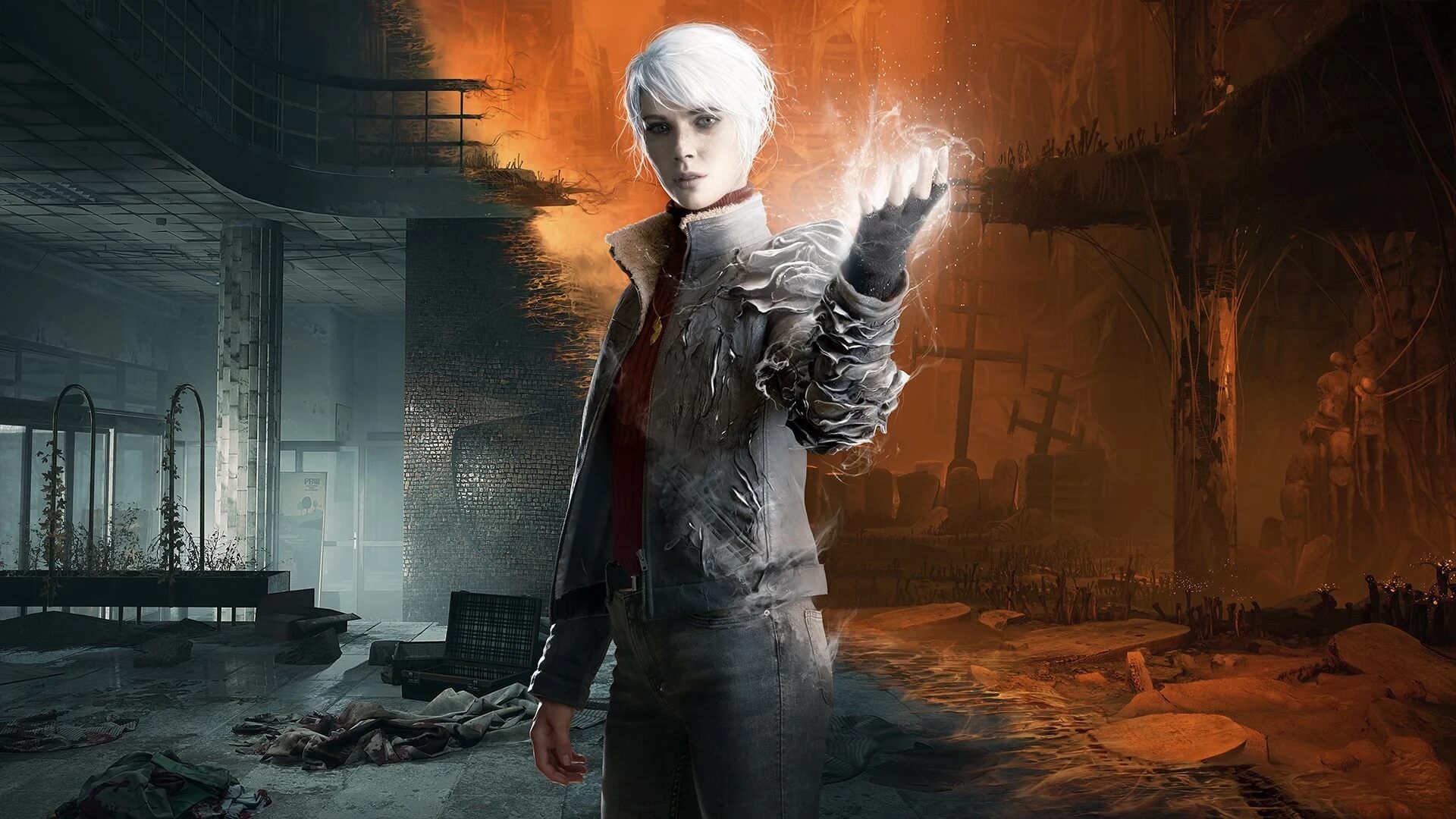
The developer’s links to Silent Hill aren’t limited to remakes or homages, though. The Medium— released as an Xbox exclusive five years ago on January 28, 2021—was marketed with its connections to the influential series. Chief among these was the involvement of composer Akira Yamaoka, singer and voice director Mary Elizabeth McGlynn, and voice actor Troy Baker. Clenching the tie was an art direction which takes liberal stylistic cues from the fixed-angle cameras of horror titles Team Silent both influenced and were influenced by.

Yet there’s a major, important distinction between both games. Silent Hill 2 arms James Sunderland with the requisite steel pipes and firearms; The Medium, however, continues what was—at the time—a house tradition for Bloober. Protagonist Marianne cannot simply bash or blast her way through complex psychoses, instead relying on her second sight to peer into a parallel world of trapped spirits and maladaptive emotions. Like Layers of Fear, Observer, and Blair Witch before it, the game tasks the player with moment-to-moment progression that resembles an adventure game more than, say, the item management and staccato action of classic Resident Evil.

Silent Hill f’s dodge-heavy combat was subject to criticism, and that’s fair—it’s an inelegant, unambitious, and often cumbersome way to engage with the game’s world and plot. But for any mechanical issues with that game, Bloober’s sluggish combat in Silent Hill 2 is much worse. Bound to an unappealing over-the-shoulder camera angle which does a disservice to the original title’s aesthetic, the game grinds to a halt for players to engage in barebones shooting and weightless melee. It is somewhat disappointing that this and Cronos have been Bloober’s biggest successes, as it ensures similar uncurious, palatable design decisions may follow.

By contrast, The Medium’s cinematography is allowed to take up more space explicitly without the burden of combat. Because of that, the game is easily able to show the player what it wants to, when it wants to. This makes it more of a deliberate work of art that isn’t dictated  by the player’s framing of the world. Fixed camera angles are controversial due to the popular misconception that the more control a player is given, the “better” a game’s controls are. But a set perspective allows for purposeful  vision akin to artful cinematography in a great film; meanwhile, no combat ensures said vision never becomes a corpse-spattered tableau of the player’s making. The game would be an uglier and less deliberate piece of art if Bloober simply gave Marianne a shotgun.

But little discussion around The Medium had to do with its camera. Instead, the game’s narrative took flak for its handling of sensitive subject matter like childhood sexual abuse and depression.

The game’s primary monster, The Maw, is the product of a young girl’s sexual trauma. Richard, a former professor, was brought to the Niwa Resort by architect and former pupil Thomas to teach children art. He harbors a dark secret: as a child, he was savagely beaten by his step-father after his biological dad died in WWII. His only respite was Rose, a young Jewish girl whom he smuggled food to in clandestine garden meetings. Richard’s mother, also brutalized by her new husband, was pushed to a breaking point and reported him to the Nazi authorities for smuggling Jews. In the process, however, Rose was discovered on the family’s property and executed; when Richard finds her body, it sets in motion a lifelong fixation on young girls akin to Humbert’s obsession in Lolita. When Richard is brought to Niwa, he gives in to his perverse impulses and molests Lilianne—Thomas’ daughter and Marianne’s sister. The young girl, confined to a bunker as her father studies her preternatural abilities, retaliates in an emotional explosion that creates The Maw and subsequently destroys the Niwa Resort.

While this is a socially inconvenient depiction of child molestation, it is a true-to-life one. More often than not, severe childhood trauma can capture someone in arrested development and stunt their sexuality. Broadly, 33% to 75% of pedophiles were abused during childhood; their attraction is often a result of either parental harm or being molested themselves. To rationalize and explain an action is not to justify it, though, and The Medium is careful to not excuse Richard from the weight of his sins. Rather, it uses his sexual dysfunction as an overt critique of fascist ideology. On a subtextual level, the writers argue Nazism cuts psychological, emotional wounds into the psyche of anyone touched by its evil. This litigates fascism as a stunted ideology—gazing to the past at the expense of harm done to the present and doom sowed for the future.

The consequences of this plot beat come to a head at the game’s climax. Marianne and sister Lilianne are chased to a place they’ve both dreamed of since girlhood—at the end of a dock, facing down death. The Maw approaches both women, as Marianne brandishes a firearm in futility. She knows that The Maw exists because Richard hurt Lilianne, and that it is the out-sized product of her pain and grief. In this moment, Marianne understands that she has three choices: fire at The Maw, kill Lilianne, or shoot herself. Two are guaranteed to end the cycle for good; but only the most hopeless one leaves them alive, albeit for a few moments.

This is when the screen goes black. A single gunshot. Credits. That’s all, folks. This is not a “spoiler” or an “explanation” because—to this day—the fates of Marianne and Lilianne are a mystery. They’re a point of conjecture and debate, something to speculate on for years to come, unless Bloober intervenes with a follow-up. If they don’t, it stands as a haunting metaphor for the murky uncertainty of a future with depression and complex PTSD. On a metaphorical level, it’s the choice those who struggle with mental health issues must live with every day: end it all, hurt someone else, or go out fighting.

Contemporary claims that The Medium is somehow “irresponsible” in its portrayal of mental health are dubious, and in some respects willfully ignorant. Similar claims have not been levied en masse towards Silent Hill f, a game in which the protagonist must kill things while she avoids taking medication in order to not have a mental breakdown and murder her family—hardly “responsible” messaging itself. Which belies a deeper point: social responsibility is a slippery criteria by which to critique most art, and to do so is often to cushion oneself from works that handle difficult subject matter with no easy answers. This is especially true of horror, whose success hinges upon the exploitation of recurrent social anxieties difficult to discuss in mixed company. Indeed, this was an intended philosophy of The Medium—“the game’s statement is that there is no universal truth,” designer Wojciech Piejko told EuroGamer.

Further, while The Medium is led by a predominately male development staff, co-creator Marlena Babieno and narrative designer Barbara Kciuk put two more women on the core creative staff than have ever been on a Silent Hill title in that capacity. It’s telling of the games crit enterprise, then, that a game which litigates sexual trauma and its effects on cis women received more overt scrutiny for its messaging than Silent Hill f—a game with adjacent preoccupations written by men. It’s also disingenuous and simple-minded to assume all narratives house a moralistic “lesson” one must internalize; if anything is an actual harm to folks who struggle with mental health, it’s this standard. In 2016, Lights Out director David Sandberg had to publicly defend the downbeat ending of his paranormal parable for depression after audiences charged it with the same offense as The Medium: somehow “encouraging” suicide. Sandberg had to explain, publicly, that he lives with depression and the film is a metaphorical reflection of his own struggles. This is a mortifying position for any artist to be put in—and criticism akin to the moral alarmism of Siskel and Ebert.

Yet five years later, games discourse predictably circled its way back to the same hairy drain. The Medium was mostly buried under overlong video essays and objectively incorrect “explainers,” parroted by online commentators who used it as further flak against Bloober Team. The announcement of Silent Hill 2 was met with subsequent hostility by the Silent Hill fanbase and general horror gaming community, who charged the developer with permissive attitudes towards child abuse and encouragement of suicide for the Richard and Lilianne plot. But time moves on. Moralistic rage finds new targets. Silent Hill 2 was a rousing success, with director Jacek Zieba noting that “they proved people wrong” and that the team is “starting to stop feeling like the underdogs all the time.” The Medium seemed to hold water with Silent Hill 2 producer Motoi Okomoto, who also worked on Silent Hill f; the game’s influence is present throughout the 2025 title, most obviously in the scripted chase sequences. With Cronos in the rear view and Silent Hill ahead, the studio has weathered criticism to come out as one of gaming’s most durable, challenging developers with a lasting influence on a prolific horror property.

With that in mind, The Medium is long overdue wider reappraisal for both its impact and newfound relevance. Now available for PlayStation 5—as well as Switch and Mac—the game holds a startling urgency in a particularly cruel time for American geopolitics. As rich pedophiles contract violent thugs to terrorize migrants and birthright citizens alike, art that explores the close intersection of fascism, child abuse, and misogyny holds a specific prescience. Who is an acceptable loss—and how might that damn the generation that follows?


First Appeared on
Source link

Leave feedback about this

  • Quality
  • Price
  • Service

PROS

+
Add Field

CONS

+
Add Field
Choose Image
Choose Video