

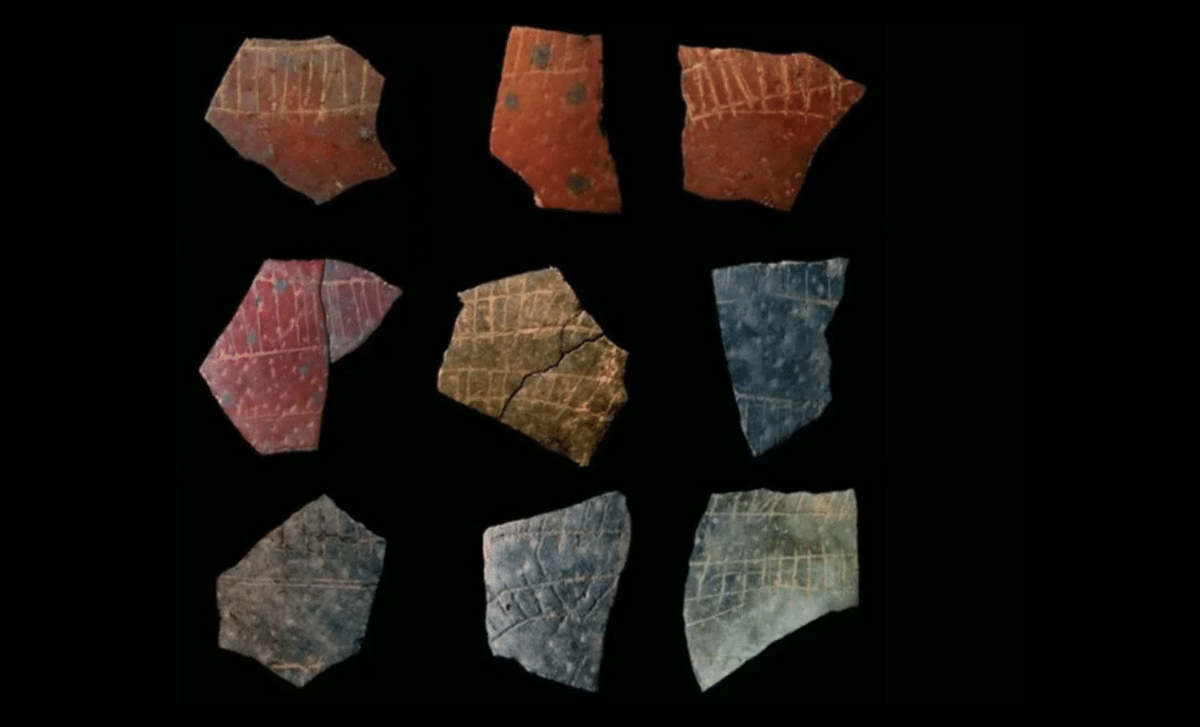
A new study published in PLOS One sheds new light on early human intelligence by revealing that 60,000-year-old ostrich eggshell fragments from southern Africa bear intricate geometric markings. These designs offer an astonishing glimpse into the advanced cognitive abilities of prehistoric humans, challenging the long-held notion that early humans were far removed from sophisticated thought processes. The analysis of these eggshell fragments uncovers highly organized geometric patterns that demonstrate early humans’ ability to think abstractly and plan complex visuals long before written language emerged.
Unveiling the Mystery of Ancient Geometric Art
The discovery of complex geometric markings on ostrich eggshells offers a fascinating window into the intellectual world of early humans. In southern Africa, researchers uncovered over 60,000-year-old ostrich eggshell fragments that had been carefully engraved with precision. This discovery stands out not only for its age but also for the level of detail and organization found in the markings. The team used geometric and statistical techniques to reconstruct the patterns, revealing their high degree of consistency. The researchers argue that these markings are not random; instead, they are carefully organized, reflecting a deep understanding of spatial relationships and geometry. According to Silvia Ferrara, a historian at the University of Bologna,
“We are talking about people who did not simply draw lines but organized them according to recurring principles—parallelisms, grids, rotations, and systematic repetitions.”
These sophisticated patterns suggest that early humans were capable of cognitive planning and abstract thinking, skills previously believed to have evolved much later in human history. The engraving’s precision indicates that these early artists had a clear mental image of their design before executing it. This finding challenges the traditional view of prehistoric humans as purely functional beings, focused solely on survival, and opens the door to understanding the origins of abstract thought and early artistic expression.
A Statistical Analysis: Understanding the Structure of Ancient Patterns
To determine how intentional the markings were, the researchers employed a rigorous statistical analysis. By focusing on key geometric features such as angles, parallel lines, grids, and repeated motifs, they were able to assess the consistency and intentionality of the markings. The results were striking, over 80% of the patterns demonstrated coherent spatial regularities. Simpler designs often featured repeated right angles and parallel lines, while more complex engravings revealed the use of rotation and repetition, suggesting a sophisticated understanding of geometric principles. Ferrara explained, “These engravings are organized and consistent and show mastery of geometric relationships.” This consistency indicates not just random doodling, but rather a deliberate and structured approach to visual art.
The patterns’ alignment and repetition showcase that these early humans were not just producing marks on a surface. They were actively engaging in what would later be recognized as visual planning, a precursor to both mathematical reasoning and artistic design. This suggests that prehistoric people were capable of engaging with the world in ways that extended beyond mere survival needs. By planning and creating these geometrically consistent designs, they may have been expressing deeper cognitive processes related to spatial reasoning and abstract thought, much like modern humans engage in when creating art or solving mathematical problems.
The Cognitive Leap: Abstract Thinking in Prehistoric Times
The study’s findings, published in PLOS One, carry profound implications for understanding the cognitive development of early humans. The precision and regularity in the geometric patterns on the ostrich eggshells suggest a level of abstract thought that goes beyond what was previously assumed for humans at that stage in history. The study suggests that these markings were more than just simple decorative scratches; they were part of a complex cognitive framework that involved both visual-spatial planning and mathematical reasoning. Silvia Ferrara noted,
“There is not only a process of repeating signs; there is real visuo-spatial planning, as if the authors already had an overall image of the figure in mind before engraving it.”
Such organized patterns hint at the cognitive abilities necessary for complex thought, including abstraction and visualization, key components of modern-day art and mathematics. It’s an intriguing prospect that early humans could have engaged with concepts like symmetry, pattern recognition, and even geometry—ideas that were previously thought to emerge much later in human evolution. This discovery not only redefines our understanding of ancient human behavior but also offers valuable insights into the evolution of human cognition.
First Appeared on
Source link






Leave feedback about this