

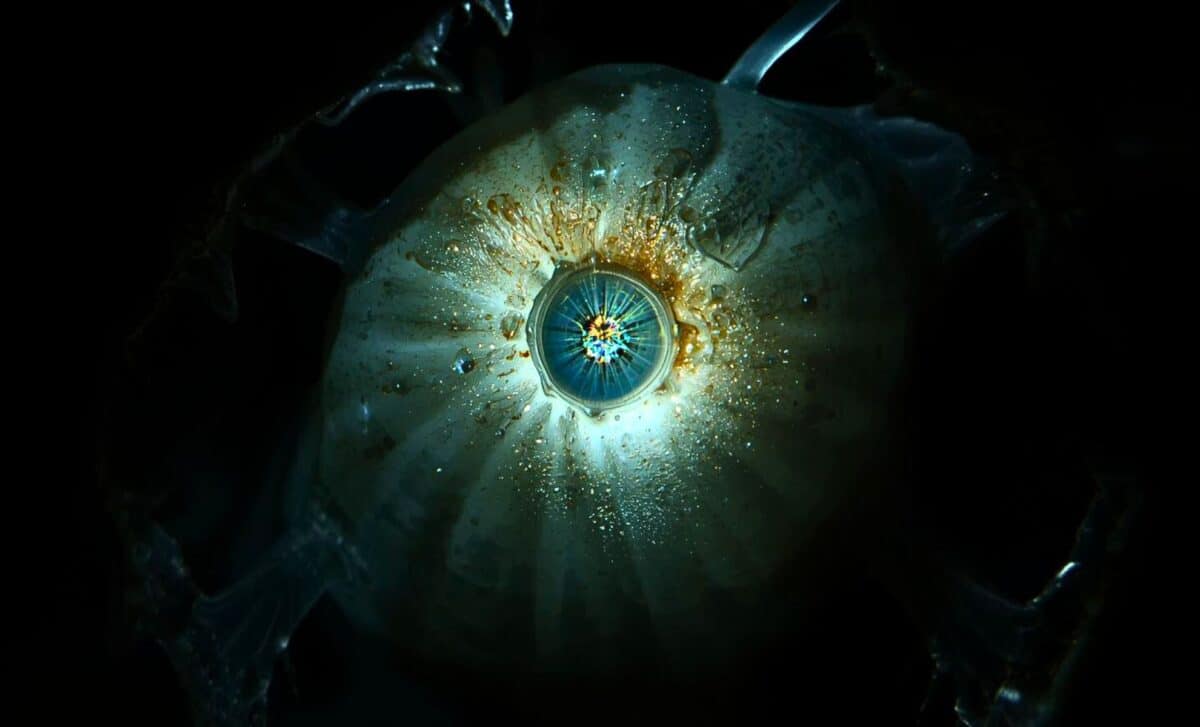
There was once a small, wormlike creature that drifted in ancient seas, filter feeding on plankton. It lived a quiet life, anchored in place, with little need to chase prey or flee from predators. Over millions of years, it lost its eyes. But not all of them.
The animal kept a single light sensitive spot on the top of its head, a primitive eye that could tell day from night and sense which way was up. That creature, a distant relative of every vertebrate alive today, existed nearly 600 million years ago. And according to new research from Lund University, the eyes in your head right now trace directly back to it.
A Surprising Turn in Eye Evolution
Biologists have long known that vertebrate eyes differ fundamentally from the eyes of insects and squid. In vertebrates, the retina develops from brain tissue. In other animal groups, eyes originate from skin cells on the sides of the head. What no one could explain was why.
A team of researchers from Lund University in Sweden and the University of Sussex now has an answer. They published their findings in Current Biology, and the conclusion upends previous assumptions about how our eyes came to be.
“We now finally understand why the eyes of vertebrates differ so radically from the eyes of all other animal groups, such as insects and squid,” said Dan E. Nilsson, professor emeritus in sensory biology at Lund University. “The film of our eyes the retina developed from the brain, whereas the eyes of insects and squid originate in the skin on the sides of the head.”
That difference exists because our ancestors took an evolutionary detour through a cyclops like phase.
The Rise and Fall and Rise Again of Vision
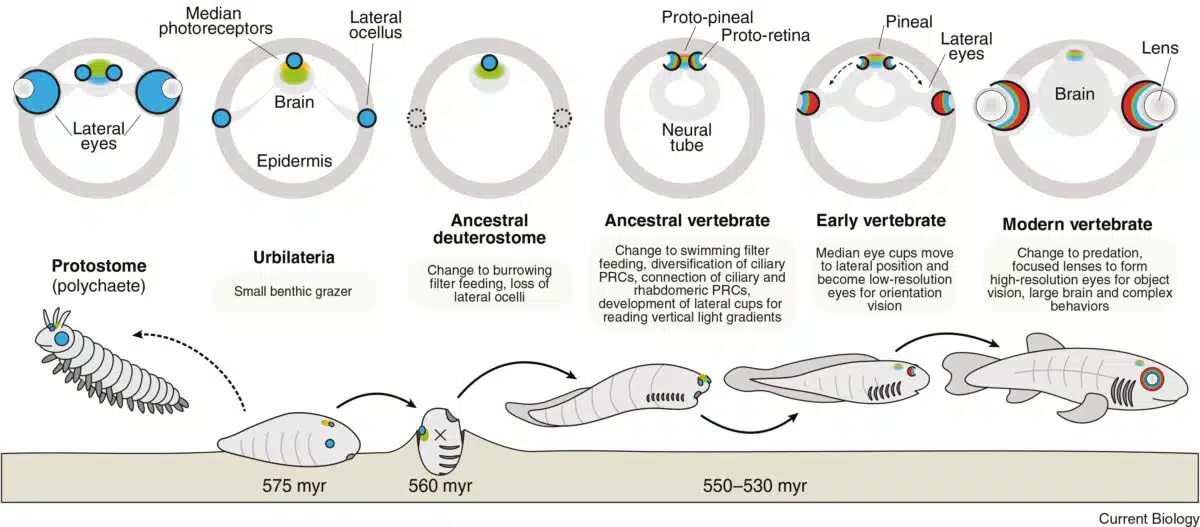
The story begins with a small, wormlike organism that lived a sedentary lifestyle. At some point in its evolutionary history, it had paired eyes on the sides of its head. But as it settled into a life of filter feeding, those eyes became unnecessary.
“We don’t know whether the paired eyes in our branch of the evolutionary tree were just light sensitive cells or simple image forming eyes,” Nilsson said. “We only know that the organism later lost them.”
What remained was a cluster of light sensitive cells in the middle of its head. Over time, these cells organized into a simple median eye, a single visual organ on the top of the creature’s skull. This eye could only detect the presence and absence of light, enough to regulate daily rhythms and maintain orientation.

Then something shifted. Descendants of that one eyed animal returned to an active, swimming life. The need for good vision returned with it. From parts of that small median eye, new image forming eyes in pairs developed. The vertebrate eye as we know it today a complex organ with a retina derived from brain tissue is the result.
What Remains in Our Heads
If the idea of a one eyed ancestor seems strange, consider what still exists inside your own skull. The pineal gland, a small organ buried deep in the vertebrate brain, is a direct descendant of that ancient median eye.
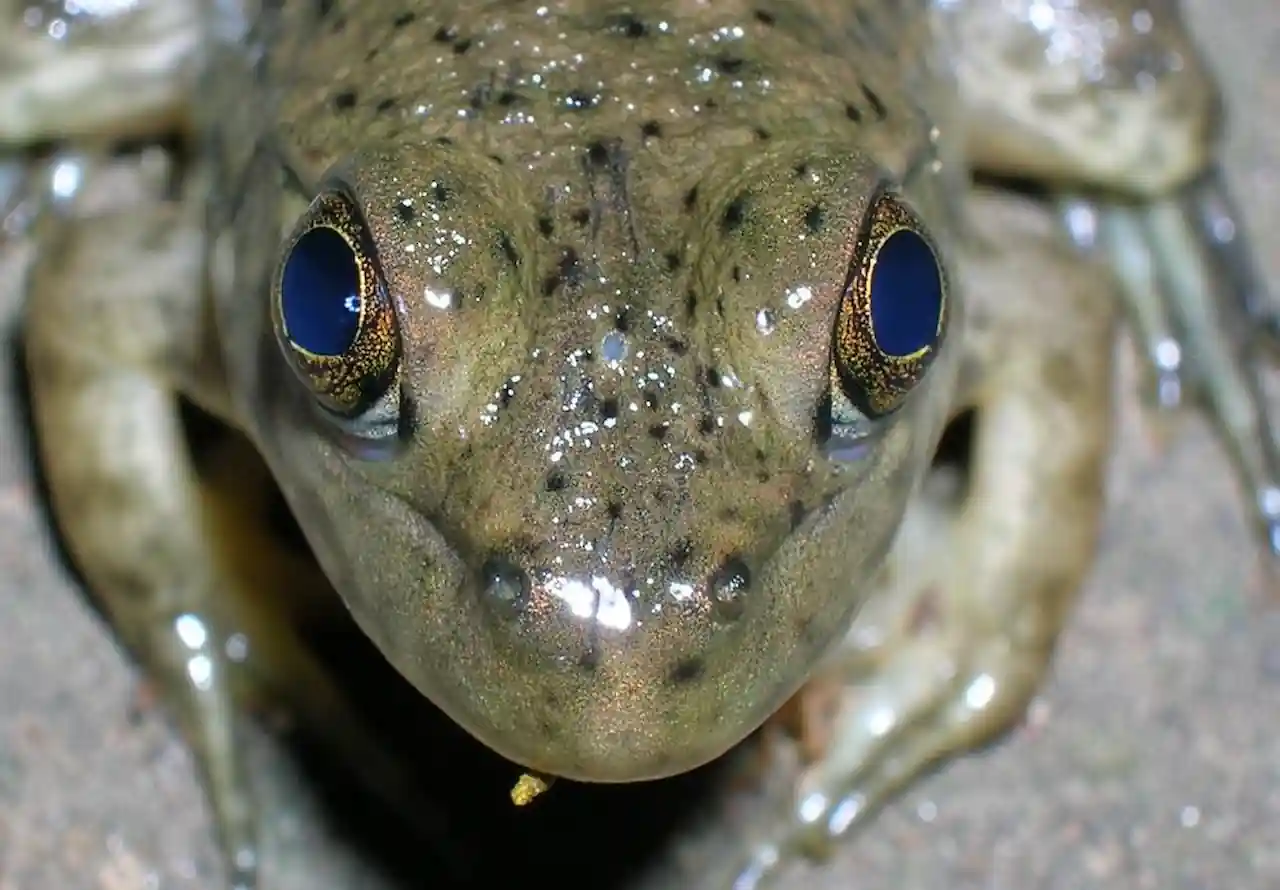
The pineal gland produces melatonin, the hormone that regulates sleep according to light exposure. It remains light sensitive in many vertebrates today. In some lizards and amphibians, it still sits close enough to the skull surface to detect light directly.
“It’s mind boggling that our pineal gland‘s ability to regulate our sleep according to light stems from the cyclopean median eye of a distant ancestor 600 million years ago,” Nilsson said.
The mechanism that wakes you in the morning and makes you drowsy at night, the internal clock that adjusts to time zones, traces back to a simple light sensor on the head of a filter feeding worm.
How They Traced the Path
The researchers did not examine fossils. Soft tissues do not fossilize well, and 600 million years erases almost everything. Instead, the team conducted an extensive analysis of light sensitive cells across all animal groups, as detailed in the university’s announcement. They compared the physiology of these cells and their placement in the body, mapping how they changed across evolutionary branches.
This comparative approach allowed them to reconstruct the sequence of events that led to the vertebrate eye. The specific arrangement of light sensitive cells and their connection to brain tissue in vertebrates points directly back to that median eye in a long lost ancestor.
“For the first time, we now also understand the origin of the neural circuits that analyse the image in our retina,” Nilsson added.
Those circuits, the wiring that allows a brain to interpret light patterns as meaningful images, began in a single spot on top of a worm’s head
An Ancestor We Never Expected
The creature at the root of all this was small, simple, and unlikely to impress anyone who could have seen it. It had no shell, no limbs, no obvious defenses. It spent its days filtering water and sensing light through the top of its skull.
But it carried the seed of something that would later become the complex, image forming eyes of fish, amphibians, reptiles, birds, and mammals including humans. Every time you read a sentence, recognize a face, or watch a sunset, you are using equipment that passed through a cyclops on its way to you.
Our eyes are not the result of a straight line from simple to complex. They are the product of a strange loop, a loss and a recovery, a repurposing of an ancient light sensor that never completely disappeared. That sensor still sits in your brain right now, ticking away, keeping time with the sun.
First Appeared on
Source link





Leave feedback about this