

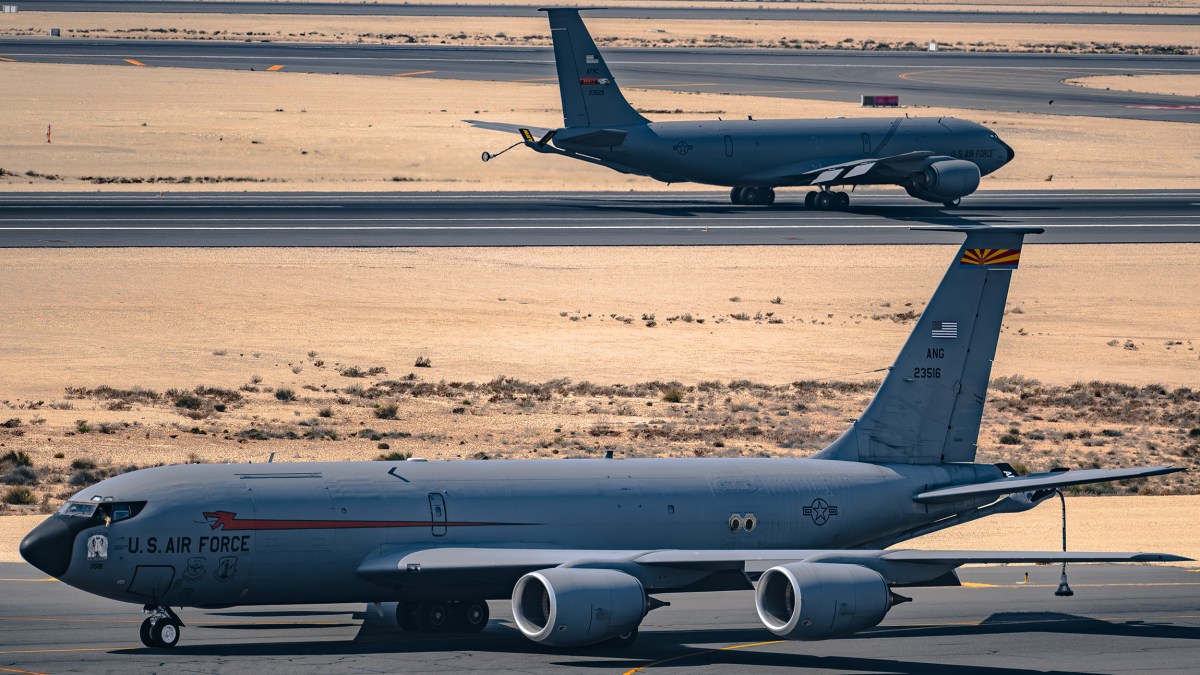
All six crew members aboard a U.S. KC-135 aerial tanker that crashed in Iraq on Thursday afternoon have been confirmed dead, U.S. Central Command announced Friday morning.
“All six crew members aboard a U.S. KC-135 refueling aircraft that went down in western Iraq are now confirmed deceased,” reads the statement. “The aircraft was lost while flying over friendly airspace March 12 during Operation Epic Fury.”
The crash occurred in “friendly territory” over western Iraq while the troops were flying a combat mission, Air Force Gen. Dan Caine, Chairman of the Joint Chiefs of Staff, told reporters on Friday.
The incident was not the result of hostile or friendly fire, Central Command said.
An initial news release about the crash said “two aircraft were involved,” and that “One of the aircraft went down in western Iraq, and the second landed safely.”
An Associated Press reporter posted on social media that the second aircraft was also a KC-135.
Most KC-135s fly with 3 crew members, according to an Air Force fact sheet — a pilot, co-pilot and a boom operator, who “flies” the refueling probe, or boom, from the rear of the aircraft (older models may also fly with a navigator).
The identities of those killed in Thursday’s crash are being withheld until 24 hours after next of kin notification — a standard process in the event of a death.
“War is hell. War is chaos. And as we saw yesterday with the tragic crash of our KC-135 tanker, bad things can happen. American heroes, all of them,” said Defense Secretary Pete Hegseth during Friday’s press briefing. “We will greet those heroes at Dover and their sacrifice will only recommit us to the resolve of this mission.”
Mishaps are uncommon but do occur
Officials did not say if the tanker was engaged in refueling when it crashed. But while air-to-air refueling is a routine skill practiced by nearly all Air Force pilots, the maneuver is inherently risky, and mishaps do occur.
The Air Force recently released a series of mishap reports on three mid-refueling accidents that all occurred between 2022 and 2024 during otherwise routine training. All three involved the refueling boom becoming lodged on a plane while refueling with a newer Air Force tanker, the KC-46.
The 2024 mishap was violent enough to rip the refueling boom off the tanker. It fell harmlessly away as the two planes separated, but could have brought down either jet had it impacted them.
Top Stories This Week
In 2013, a KC-135 crashed in the Kyrgyz Republic while supporting operations over Afghanistan. Air Force investigators determined that crash was unrelated to combat. The plane broke apart in mid-air after the autopilot incorrectly reacted to steering issues and the two relatively inexperienced pilots did not properly react.
Based on a commercial airliner, KC-135’s are among the Air Force’s oldest airplanes, originally entering service in 1956. They are also among the most frequently called up. The plane’s mission — refueling other aircraft, from fighters to cargo planes — during flight has been one U.S. Air Force’s primary strategic advantages in conflicts dating to Vietnam.
The Air Force has about 400 KC-135s, with mission-capable rates of about 70%, according to 2023 data. Multiple efforts to replace the KC-135 with newer tankers in recent decades — first with KC-10s, then the KC-46, along with leasing plans for other aircraft — have foundered in budget and delivery issues.
UPDATE: 3.13.2026; This article was updated after publication with statements from U.S. Central Command and the Chairman of the Joint Chiefs of Staff noting that six U.S. servicemembers have been confirmed dead as a result of the March 12, 2026, KC-135 crash in Iraq.
Task & Purpose Video
First Appeared on
Source link






Leave feedback about this