

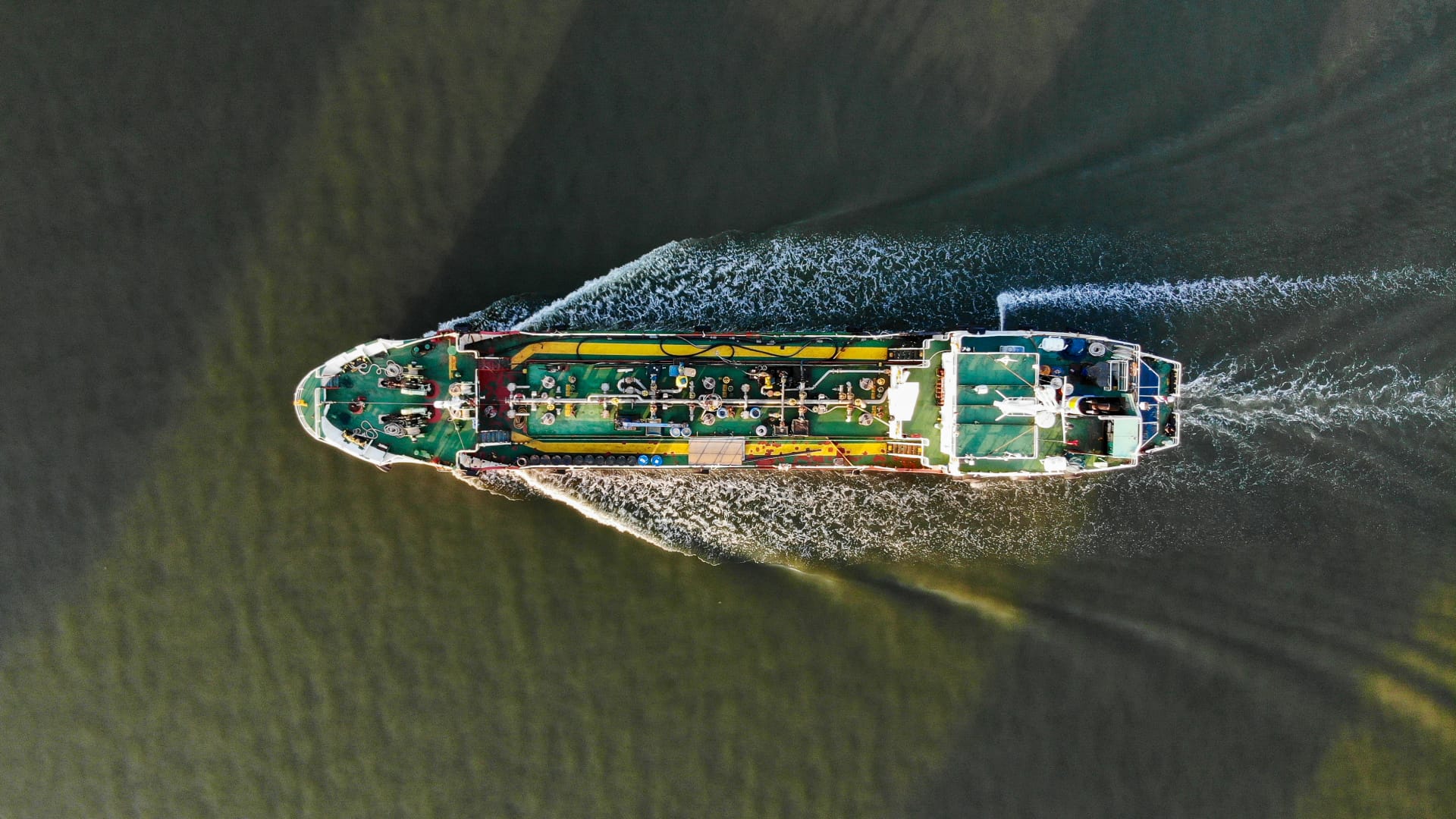
Oil tankers and gas tankers were affected by the closure of the Strait of Hormuz, leading to a global energy crisis stemming from the war in the Middle East.
Photos For You | Moment | Getty Images
Crude oil prices surged on Monday as the U.S. Navy prepares to impose a blockade on Iran’s ports after peace talks failed over the weekend.
U.S. crude oil futures for May delivery jumped over 7% to $103.66 per barrel by 5:04 a.m. ET. International benchmark Brent for June delivery advanced 7.2% to $102.05.
U.S. Central Command said Sunday the military will blockade all maritime traffic entering and exiting Iranian ports on Monday at 10 a.m. ET. It added that the U.S. will not impede vessels transiting to and from non-Iranian ports.
“The blockade will be enforced impartially against vessels of all nations entering or departing Iranian ports and coastal areas, including all Iranian ports on the Arabian Gulf and Gulf of Oman,” CENTCOM said in a statement.
President Donald Trump had threatened earlier Sunday to blockade the Strait of Hormuz after the U.S. and Iran failed to reach an agreement to end the war during negotiations in Pakistan.
“Effective immediately, the United States Navy, the Finest in the World, will begin the process of BLOCKADING any and all Ships trying to enter, or leave, the Strait of Hormuz,” Trump said in a social media post.
Trump is considering limited strikes on Iran to break the stalemate in peace talks, officials and people familiar with the matter told The Wall Street Journal.
The president said Sunday he ordered the Navy to find and interdict any ship in international waters that has paid Iran a toll to transit the strait. The narrow sea route is a vital artery that connects Middle East oil producers to global energy markets.
Tanker traffic through the strait has plunged due to the threat of Iranian attacks, triggering the largest oil supply disruption in history. About 20% of global oil supplies passed through the waterway before the U.S. and Israel attacked Iran on Feb. 28.
It is unclear whether Trump will now resume airstrikes on Iran. The president agreed to a two-week ceasefire on Tuesday in exchange for Tehran allowing ships to pass through the strait. He had previously threatened to bomb every bridge and power plant in Iran.
Tehran has made safe passage during the ceasefire contingent on its approval. Ali Akbar Velayati, a senior advisor to Iran’s Supreme Leader Mojtaba Khamenei, said Sunday that the “key to the Strait of Hormuz” remains in the Islamic Republic’s hands, according to state news agency Press TV.
Three supertankers made the journey on Saturday, according to data from LSEG. Each vessel can carry up to two million barrels of oil. But traffic is well below pre-war levels when more than 100 vessels made the trip daily.
Vice President JD Vance, who led the U.S. delegation, said Sunday the negotiations failed because Iran would not provide an “affirmative commitment” that they will not seek a nuclear weapon.
“The simple question is, do we see a fundamental commitment of will for the Iranians not to develop a nuclear weapon?” Vance told reporters in Islamabad. “We have not seen that yet; we hope that we will.”
Iran’s parliamentary speaker Mohammad-Bagher Ghalibaf said the U.S. “failed to gain the trust of the Iranian delegation in this round of negotiations.”
“The volume of ships passing the Strait needs to surge in the coming two weeks for the oil market to be convinced that the crisis is over,” said Malcolm Melville, a commodities fund manager at Schroders.
“If the vessel number surges to 75% of prewar levels, then that represents a near normalization of flows, given the current use of pipelines that were not previously running at full capacity.”
First Appeared on
Source link




Leave feedback about this