

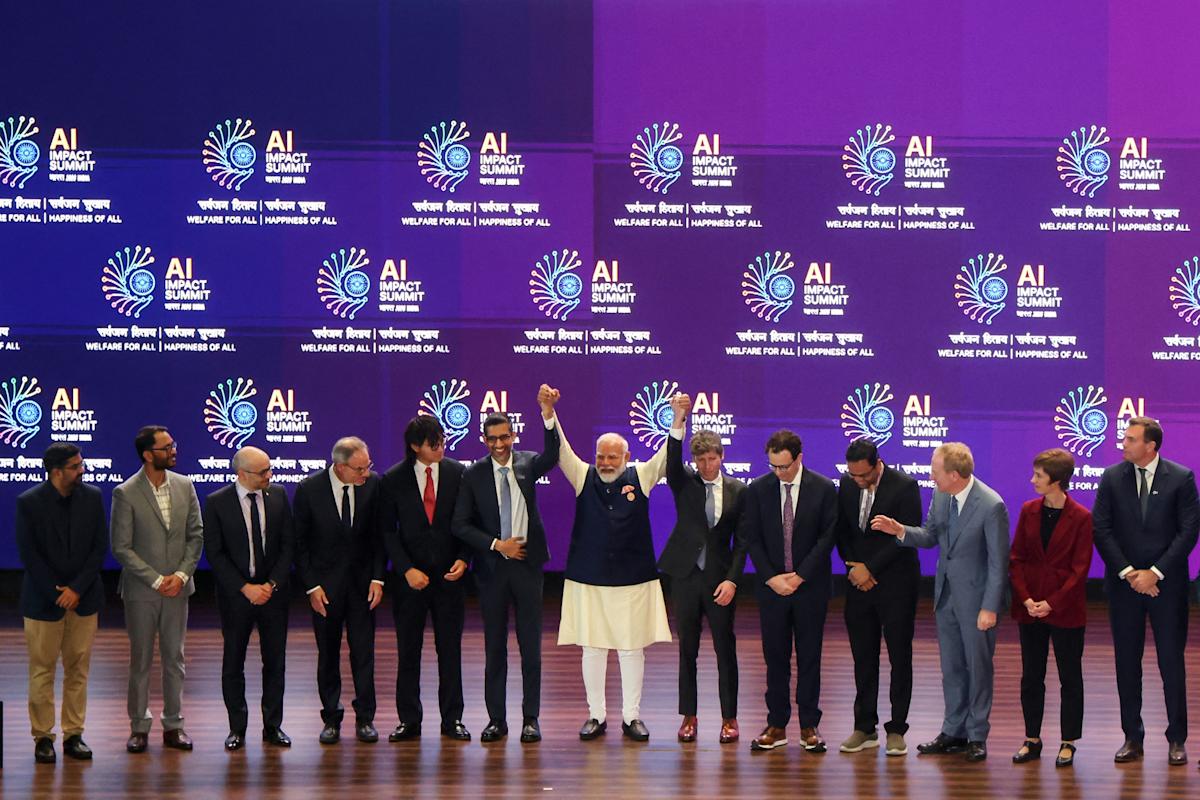
(Bloomberg) — Prime Minister Narendra Modi made his pitch this week that India can play a leading role in the artificial intelligence boom with a conference featuring tech stars from around the world. It suffered more than a few hitches.
Nvidia Corp.’s Jensen Huang dropped out after early promotion; Bill Gates withdrew later. Many attendees ran into trouble just getting into the grand Bharat Mandapam venue in New Delhi on Monday and logistics remained an ordeal all week. Mukesh Ambani, Asia’s richest man, had so much trouble getting through security that his speech — announcing the biggest deal of the India AI Impact Summit — was delayed.
Most Read from Bloomberg
Even so, Modi gave a forceful demonstration of the country’s influence. He gathered many of the most prominent names in the tech industry, including the chief executives of Alphabet Inc., OpenAI and Anthropic PBC, as well as the India-born CEOs of global corporate icons like FedEx Corp. The prime day of the summit was so jam-packed that celebrity leaders like Sundar Pichai and Sam Altman were allocated a mere five to 12 minutes each.
“It’s one thing to say you’re the leader of the Global South and it’s another to come across as the leader of the Global South,” said Reema Bhattacharya, head of Asia risk insights at advisory firm Verisk Maplecroft. “They’ve achieved what they wanted to achieve.”
The event mixed moments of genuine promise with evidence of India’s constraints as the global AI race accelerates. Similar to US President Donald Trump, Modi is able to elicit effusive praise and big promises from industry and government leaders, with Ambani pledging $110 billion for building out artificial intelligence projects across India over the next seven years. Speakers constantly praised the prime minister for his leadership and referred to him in the honorific, Shri Narendra Modi Ji.
But the country still lags in high-end computing infrastructure that’s necessary to build frontier large language models such as those produced by Silicon Valley companies or the coterie of Chinese upstarts that now sit atop many AI benchmark lists. Even the most efficient AI systems require tens of billions of dollars to build and operate, in a capital-intensive contest that US Big Tech in recent weeks escalated with plans for $650 billion in new spending in 2026.

First Appeared on
Source link





Leave feedback about this