


The research, presented in two papers in Physical Review A, describes adjustable exchange statistics and a method to map them. It extends a concept once confined to two-dimensional materials into an even more constrained quantum setting.
In the three-dimensional world, elementary particles are sorted into two categories defined by quantum spin and exchange behavior. Bosons, including photons, gluons, the Higgs boson, and the W and Z bosons, carry integer spin and can share the same quantum state. Fermions, protons, neutrons, electrons, and neutrinos, have half-integer spin and cannot occupy the same state, a rule that keeps matter structurally intact.
That division has long appeared complete. Yet for decades, physicists have known of exceptions in lower dimensions. According to Popular Mechanics, researchers at the Okinawa Institute of Science and Technology (OIST) and the University of Oklahoma now report that the boson-fermion binary can also be broken in one dimension.
A “Third Kingdom” Beyond Bosons and Fermions
The idea of anyons emerged about 50 years ago as a theoretical possibility in two-dimensional systems. These quasiparticles behave as something between a boson and a fermion. American physicist Frank Wilczek coined the term “any-on,” suggesting they could take on “any” value between the two statistical limits.
Experimental confirmation came in 2020, when anyons were observed in one-atom-thick semiconductors. As reported by Popular Mechanics, Wilczek described the achievement bluntly: “We had bosons and fermions, and now we’ve got this third kingdom.” He called it “absolutely a milestone,” marking the first direct evidence that particle statistics in two dimensions can depart from the strict binary seen in three-dimensional space.
The Exchange Factor That Defines Particle Identity
The distinction between bosons and fermions rests on what physicists call the exchange factor. In three dimensions, when two identical particles swap places, the square of this factor must equal 1. This mathematical requirement limits possibilities to two values: -1 for fermions and 1 for bosons.
Lower dimensions alter that rule. According to a press statement, Raúl Hidalgo-Sacoto, a Ph.D. student at OIST, explained that in two dimensions, “to satisfy the law of indistinguishability, we need exchange factors over a continuous range to account for the exchange, dependent on the exact twists and turns of the paths.” Any value between -1 and 1 corresponds to an anyon.
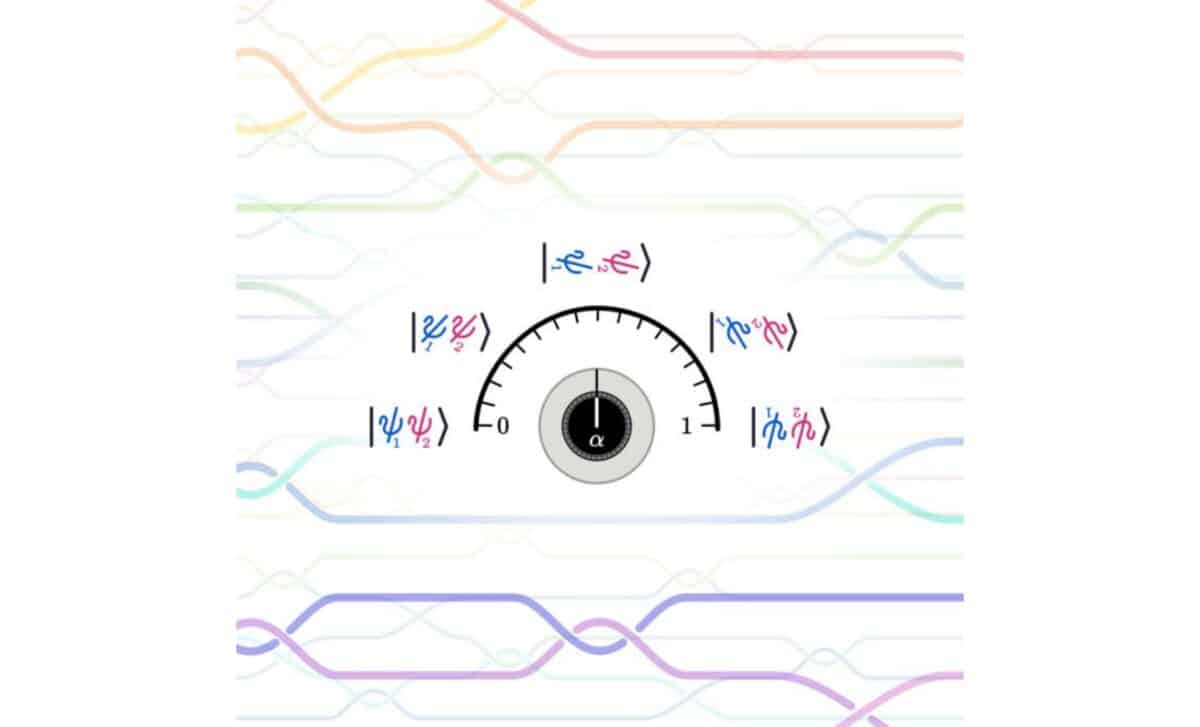
Anyons exist in these reduced dimensions because particles have fewer options for moving around. The constraints of the space directly affect how their exchange statistics are defined.
Breaking the Binary in One Dimension
In the newly published studies, Thomas Busch and Raúl Hidalgo-Sacoto of OIST, together with Doerte Blume from the University of Oklahoma, describe a one-dimensional system where anyons can also arise. The researchers present both the theoretical properties of these particles and a “recipe” for adjustable anyons.
In one dimension, particles must pass through each other, since they cannot move around one another as they can in higher dimensions. This constraint changes the exchange factor, likely linking it to the strength of short-range interactions between particles. The team also demonstrates how the exchange statistics can be mapped.
“We’ve identified not only the possibility of existence of one-dimensional anyons, but we’ve also shown how their exchange statistics can be mapped,” Busch said in a press statement. He posed a question that cuts to the heart of the field: “Every particle in our universe seems to fit strictly into two categories: bosonic or fermionic. Why are there no others?”
With these findings, the familiar boson-fermion divide remains intact in three dimensions. In lower-dimensional systems, though, the map of quantum behavior is proving far less rigid, and far more nuanced.
First Appeared on
Source link






Leave feedback about this